
Should You Pop a Boil? Why Doctors Say No
It’s tempting, but squeezing or lancing a boil at home can spread the infection. Here’s why doctors say no, what to do instead, and when a boil needs a doctor.
- Never squeeze, prick or cut open a boil yourself. It can spread the infection.123
- Warm, moist compresses several times a day can ease pain and help a small boil drain on its own.12
- Keep the area clean and covered, wash your hands after touching it, and wash anything that touched it.12
- If a boil is large, on your face or spine, comes with fever, or keeps coming back, a doctor should look at it.45
The short answer: don’t
No. Dermatologists and major medical centers agree: never squeeze, prick or cut open a boil yourself.13 It can spread the infection to other parts of your skin.3
A boil is an infection of a hair follicle, usually caused by staph bacteria.3 Small boils can usually be cared for at home and allowed to drain naturally, while large ones can be drained safely by a doctor.2 The goal is to help the boil along without forcing it.
Why squeezing backfires
Squeezing a boil can go wrong in several ways:
- It spreads the infection. Pressing on a boil can push bacteria into nearby skin and start new infections.13
- It brings in more germs. Fingers, pins and household tools aren’t sterile.
- It spreads staph around you. Pus on your hands, towels or clothing can carry the bacteria to other people, which is why careful handwashing and laundry matter.2
A carbuncle, a cluster of boils joined under the skin, is deeper and more serious. It is more likely to scar and can cause fever and chills.5 Carbuncles need a doctor, not home care alone.
In rare cases, bacteria from a boil can get into the bloodstream and cause serious infections elsewhere in the body.5 That’s one more reason to leave the draining to a professional.
What to do instead
For a small boil, these steps from dermatologists and major medical centers can ease pain and help it heal:124
- Hold a warm, moist compress, such as a clean damp washcloth, on the boil for about 10 to 15 minutes, three or four times a day.
- Keep using warm compresses after the boil opens and starts to drain.
- Keep the area clean and try not to touch it.
- If it opens, cover it with a sterile bandage.
- Wash your hands well every time you touch the boil or its bandage.
- Wash towels, washcloths and clothing that touched the boil, and don’t share them.
For pain, the American Academy of Dermatology notes you can use an over-the-counter pain reliever, following the package directions.1 Ask a pharmacist or doctor first if you take other medicines or have health conditions.
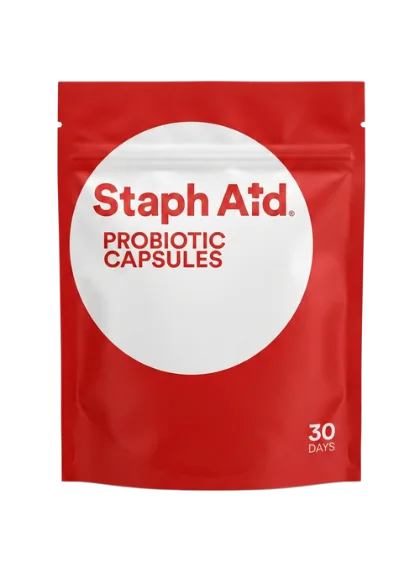
StaphAid is one capsule a day of our proprietary probiotic formula with Vitamin C, formulated to support skin, gut and immune health.* It is not a treatment for any infection.
Learn about StaphAidHow long does a boil take to heal?
Most boils heal within one to three weeks.1 A boil usually grows for a few days, then forms a yellow-white tip that breaks open and drains.5 Warm compresses can help relieve pain and pressure while you wait.3
If a boil isn’t getting better with home care, don’t keep waiting. MedlinePlus advises calling your provider if a boil doesn’t heal within about a week of home treatment.4
If a boil opens on its own
Sometimes a boil breaks open by itself. That’s part of how it heals, and it’s different from forcing it. If it happens:124
- Gently clean the area and cover it with a sterile bandage.
- Keep using warm, wet compresses on the area.
- Change the bandage when it gets damp or dirty, and wash your hands before and after.
- Wash anything that touched the drainage, including towels and compresses.
Keep an eye on it. Redness that spreads, new swelling or a fever means it’s time to call a doctor.
What a doctor does instead of popping it
When a boil is large or not healing, a doctor may drain it by making a small cut, called incision and drainage.23 This is done with sterile tools, and it lets the doctor clear the pus fully and safely.
The doctor may also send a sample of the pus to a lab. That shows which bacteria are involved and whether they resist certain antibiotics, such as MRSA.2 For severe or repeat infections, the doctor may prescribe antibiotics.23 Only a doctor should decide whether you need them. Not sure your bump is a boil? See boil, pimple or cyst.
When to see a doctor
Call a doctor if a boil:45
- Is on your face or spine, or affects your vision
- Gets worse quickly or is extremely painful
- Comes with a fever
- Keeps growing despite home care, or isn’t healing
- Comes back, or you have several at once
If you have diabetes or a weakened immune system, see a doctor for any boil. Get urgent care or call 911 for fever with fast-spreading redness, confusion, trouble breathing or feeling very unwell. And if boils keep returning, read why boils keep coming back.
- American Academy of Dermatology. How to treat boils and styes. https://www.aad.org/public/everyday-care/injured-skin/treat-boils-styes
- Mayo Clinic. Boils and carbuncles: Diagnosis and treatment. https://www.mayoclinic.org/diseases-conditions/boils-and-carbuncles/diagnosis-treatment/drc-20353776
- Cleveland Clinic. Boils and Carbuncles. https://my.clevelandclinic.org/health/diseases/15153-boils-and-carbuncles
- MedlinePlus, U.S. National Library of Medicine. Boils. https://medlineplus.gov/ency/article/001474.htm
- Mayo Clinic. Boils and carbuncles: Symptoms and causes. https://www.mayoclinic.org/diseases-conditions/boils-and-carbuncles/symptoms-causes/syc-20353770
This article is for general education and is not medical advice. If you think you have an infection, see a doctor. These statements have not been evaluated by the Food and Drug Administration. This product is not intended to diagnose, treat, cure, or prevent any disease.