


Community MRSA vs. Hospital MRSA: What’s the Difference?
Both are MRSA. The labels describe where the infection started, and often which strain caused it. Here’s how the two differ and why the line has blurred.
- MRSA is staph that doesn’t respond to some common antibiotics. It can spread in hospitals and in everyday community settings.1
- Hospital (healthcare-associated) MRSA mostly affects patients after surgery, with medical devices, or in long-term care.2
- Community MRSA usually spreads by skin-to-skin contact among healthy people and most often causes skin infections.25
- You can’t tell which type you have by looking. If a skin infection is red, painful and getting worse, see a doctor.1
The short answer
Community MRSA and hospital MRSA are both methicillin-resistant Staphylococcus aureus: staph that doesn’t respond to several common antibiotics.1 The labels mostly describe where someone picked up the infection. They also tend to point to different strains, different people and different kinds of infection.
Staph itself is very common. About one in three people carry it on their skin or in their nose, usually with no problems.1 Trouble starts when it gets into a wound, a medical device or the bloodstream. For the basics, see our guide to what MRSA is.
Hospital MRSA: tied to medical care
Healthcare-associated MRSA is the kind you get during or after a stay in a hospital or other care setting.2 For tracking purposes, the CDC counts a bloodstream infection as hospital-onset when the positive test is taken on the fourth day of a hospital stay or later.3
The people most affected are:2
- Hospital patients, especially older adults and people with weakened immune systems
- People who have had surgery
- People with IV lines, catheters or other medical tubing
- Residents of long-term care facilities
Because these patients are already sick and their skin has openings, hospital MRSA can cause serious infections. Hospital MRSA more often causes invasive infections, meaning infections that reach deeper than the skin.5 Serious MRSA infections can involve the bloodstream, lungs, bones, joints or heart valves.2 Hospital strains are also more likely to resist several kinds of antibiotics at once.5
Community MRSA: spread in everyday life
Community-associated MRSA shows up in people who haven’t had a recent hospital stay or medical procedure.5 It usually spreads through skin-to-skin contact and shared items.2 Cuts and scrapes from contact sports, and crowded places like military camps and childcare centers, give it more chances to spread.2 Groups with higher risk include athletes, students in schools and daycare, military members living in barracks, and people who inject drugs.1
Community MRSA most often causes skin and soft tissue infections, such as boils, abscesses and cellulitis.5 These often start as swollen, painful bumps that look like pimples or spider bites.2 Many community strains carry a toxin called Panton-Valentine leukocidin (PVL), which is linked to these skin infections.5
One community strain, called USA300, became the most common type of MRSA in the United States by 2011.4

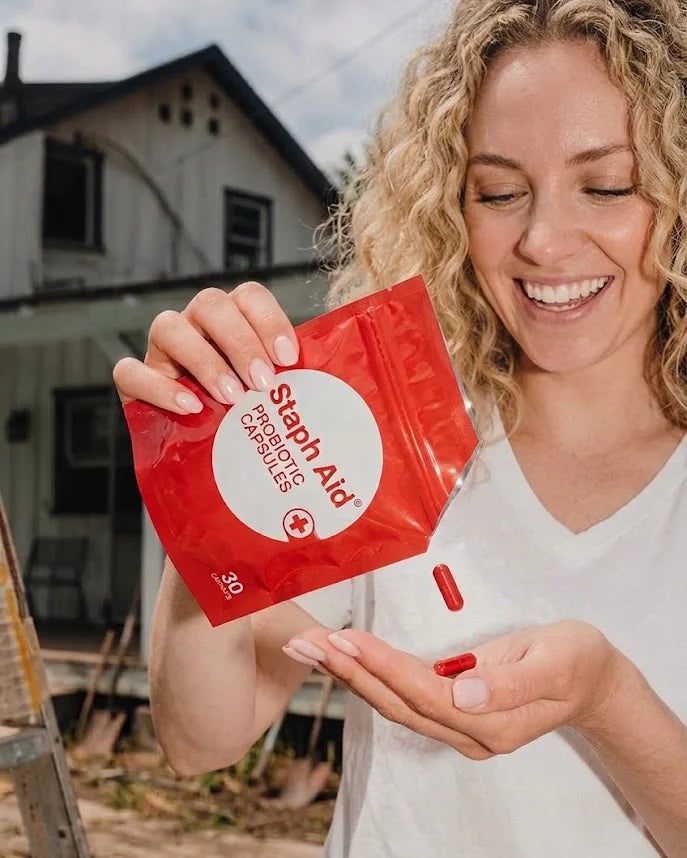
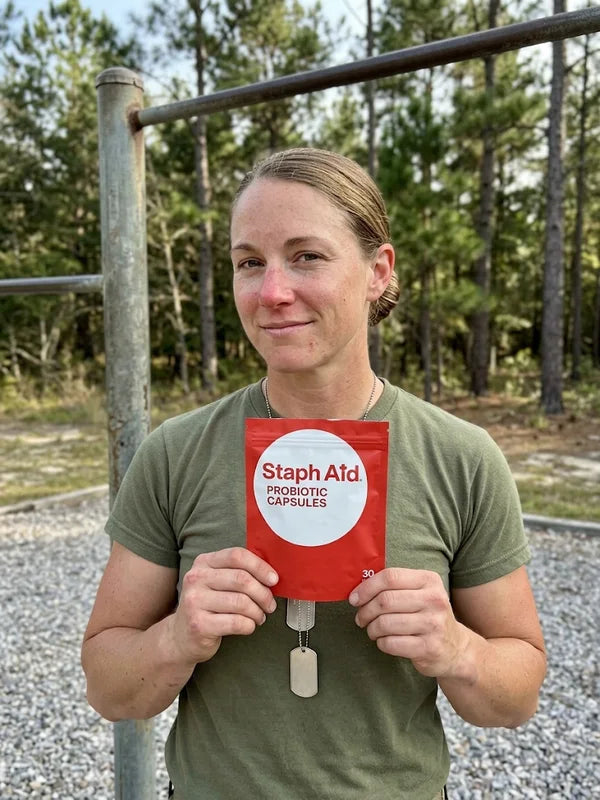
StaphAid is one capsule a day of our proprietary probiotic formula with Vitamin C, formulated to support skin, gut and immune health.* It is not a treatment for any infection.
Learn about StaphAidWhy the line has blurred
The two types used to stay in their own lanes. Not anymore. Soon after USA300 began spreading in the community, it also became a common cause of infections inside hospitals.4 Today a patient can bring a community strain into a hospital, and a patient can carry a hospital strain home.
Hospitals have made real progress. From 2005 to 2016, hospital-onset MRSA bloodstream infections in the U.S. fell by 74%, while community-onset ones fell by 40%.3 The CDC also noted that progress slowed after 2012, and that MRSA carried in the community feeds new cases in healthcare settings.3
Does the difference matter to you?
For your doctor, it can. The two types often respond to different antibiotics, so a doctor may test a sample from the infection before choosing treatment.5 That choice belongs to your doctor, not to guesswork at home.
For you, the more useful question is where you spend your time. The CDC suggests different habits for different settings:6
- At home, school or the gym: clean your hands often, keep cuts covered until they heal, don’t share towels or razors, and put a towel or clothing between your skin and shared equipment.
- As a patient: clean your hands before and after changing a wound dressing, and tell your care team if the skin around an IV line or catheter starts to look infected.
- As a visitor: clean your hands when you enter and leave a patient’s room, and ask whether you need a gown or gloves.
If you’re heading in for surgery, our guide to staph in hospitals covers more questions to ask.
When to see a doctor
You can’t tell by looking whether a skin infection is MRSA.1 Get checked if you notice:
- A bump or area that is red, swollen, warm, painful or draining pus1
- A wound that looks infected, especially if you also have a fever2
- Redness around a surgical cut, IV line or catheter site
- A skin infection that keeps coming back, or that spreads to people you live with
Get urgent care or call 911 for a fever with fast-spreading redness, trouble breathing, confusion, or feeling very unwell. Don’t squeeze or drain a bump yourself; let a doctor decide on the right treatment.
- Centers for Disease Control and Prevention. Methicillin-resistant Staphylococcus aureus (MRSA) Basics. https://www.cdc.gov/mrsa/about/index.html
- Mayo Clinic. MRSA infection: Symptoms and causes. https://www.mayoclinic.org/diseases-conditions/mrsa/symptoms-causes/syc-20375336
- Kourtis AP, Hatfield K, Baggs J, et al. Vital Signs: Epidemiology and Recent Trends in Methicillin-Resistant and in Methicillin-Susceptible Staphylococcus aureus Bloodstream Infections, United States. MMWR 2019;68(9). https://www.cdc.gov/mmwr/volumes/68/wr/mm6809e1.htm
- Carrel M, et al. USA300 Methicillin-Resistant Staphylococcus aureus, United States, 2000-2013. Emerging Infectious Diseases 2015;21(11). https://wwwnc.cdc.gov/eid/article/21/11/15-0452_article
- Tobin EH, Jogu P, Koirala J. Methicillin-Resistant Staphylococcus aureus. StatPearls, NCBI Bookshelf. https://www.ncbi.nlm.nih.gov/books/NBK482221/
- Centers for Disease Control and Prevention. Preventing Methicillin-resistant Staphylococcus aureus (MRSA). https://www.cdc.gov/mrsa/prevention/
This article is for general education and is not medical advice. If you think you have an infection, see a doctor. These statements have not been evaluated by the Food and Drug Administration. This product is not intended to diagnose, treat, cure, or prevent any disease.