

What Is MRSA? A Plain-English Guide
MRSA is a type of staph that some antibiotics can’t stop. Here’s where people pick it up, what an infection looks like, and how doctors handle it.

- MRSA is a type of staph bacteria that resists several common antibiotics.
- About 2 in 100 people carry MRSA without being sick.
- It spreads through contact with infected skin, wounds and things that touched them.
- A skin infection with a fever, or one that isn’t improving, needs a doctor.
MRSA in plain English
MRSA stands for methicillin-resistant Staphylococcus aureus. It is a type of staph, a common bacteria, that can resist several antibiotics.1 MRSA isn’t a separate disease. It causes the same kinds of infections as other staph. The difference is that some usual antibiotics don’t work on it, so doctors have to choose treatment with care. For a side-by-side look, see Staph vs. MRSA.
It also helps to know the difference between carrying MRSA and having an infection. About two in every 100 people carry MRSA, usually on the skin or in the nose.2 Most of them have no symptoms at all. This is called being colonized.
Colonized people can still pass MRSA to others without knowing it.2 An infection happens when the bacteria get inside the body, most often through a break in the skin.
Where people pick it up
MRSA spreads through contact with infected people, wounds, or things that have touched infected skin.1 Doctors often group cases by where they start.
In healthcare settings, the risk is higher for people who:3
- Have long stays in a hospital or long-term care facility
- Are on kidney dialysis
- Are getting cancer treatment or medicines that weaken the immune system
- Have surgery or medical devices placed in the body2
In the community, it shows up more often in:3
- Athletes who share towels or razors
- Children in day care
- Military members
- People who inject drugs
- People who have tattoos or recently had the flu
What an infection looks like
Most MRSA infections show up on the skin as a bump or sore that is red, swollen, painful, warm to the touch or full of pus. It may come with a fever.1 People sometimes mistake it for a spider bite.1 Cuts, scrapes, rubbed skin and hairy areas are common starting points.3
Less often, MRSA moves deeper, into the bones, joints, blood or organs such as the lungs or heart.3 Signs of a more serious infection can include fever, chills, cough, shortness of breath, chest pain, headache, rash, or a wound that won’t heal.3

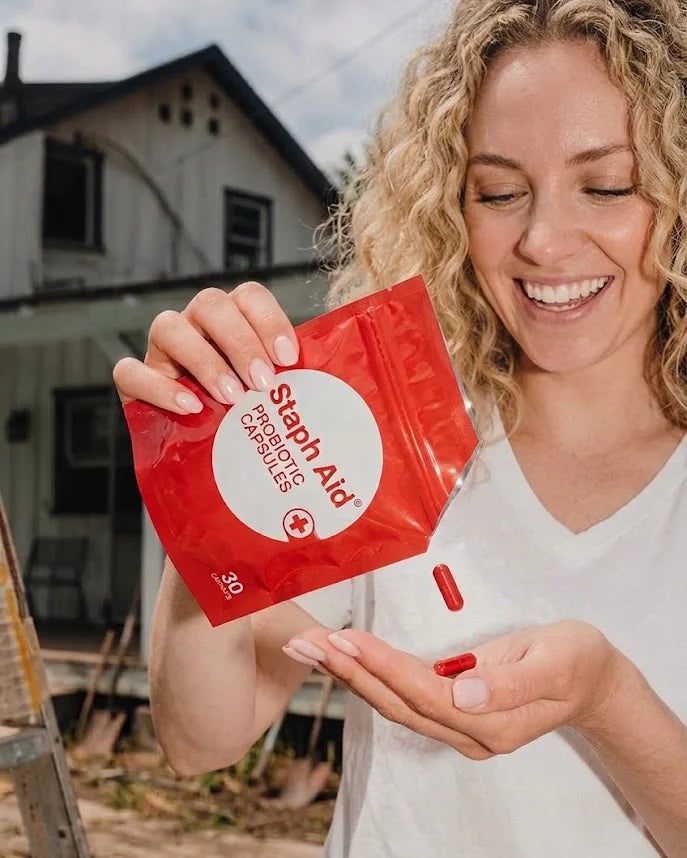
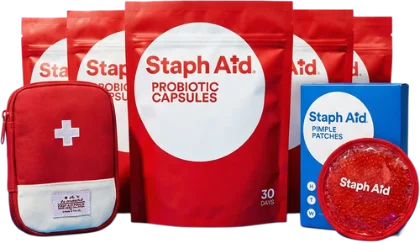
StaphAid is one capsule a day of our proprietary probiotic formula with Vitamin C, formulated to support skin, gut and immune health.* It is not a treatment for any infection.
Learn about StaphAidHow doctors handle it
The only way to know if an infection is MRSA is a lab test. A doctor takes a sample from the skin, blood, urine or pus and checks which antibiotics will work.3
For a skin infection that hasn’t spread, draining it may be the only treatment needed.3 That is a job for a doctor, never something to do at home. For more serious infections, doctors choose antibiotics based on the test results, and some people need to keep taking them for a long time, even after leaving the hospital.3 If you are prescribed antibiotics, take them exactly as directed.4
There is also some good news. The CDC estimates that MRSA cases among hospitalized patients fell from about 401,000 in 2012 to about 323,700 in 2017, although progress on hospital bloodstream infections has slowed.5
Common questions
Can I have MRSA and not know it? Yes. Most people who carry it have no symptoms.2
Is MRSA only a hospital problem? No. It also spreads in the community, including among athletes, children in day care and military members living in barracks.1
Is it contagious? Yes. It passes through contact with infected skin, wounds and shared items.1 Our guide Is MRSA Contagious? explains how long you can spread it.
What if skin infections keep coming back? Tell your doctor. Repeat infections are worth a closer look, for you and for the people you live with.
When to see a doctor
Contact a doctor if you notice:
- A red, swollen, painful or warm bump, especially with a fever1
- A sore that isn’t getting better within 48 hours1
- A wound that is getting worse instead of healing3
- Any skin infection in someone who is older, has diabetes or has a weakened immune system
Get urgent care or call 911 for a fever with fast-spreading redness, chest pain, trouble breathing, confusion, or feeling very unwell.
Until you can be seen, cover the area with clean, dry bandages, don’t pick at or pop the sore, and clean your hands often.1
Everyday ways to lower your risk
- Wash your hands often, especially after exercise.4
- Shower soon after working out, and don’t share soap.3
- If you share sports equipment, wipe it down with an antiseptic wipe before you use it.3
- Keep cuts and scrapes clean and covered until they heal.4
- Don’t pick at or pop sores.4
- Don’t share towels, washcloths or razors.4
- Put a towel or clothing between your skin and shared surfaces, like gym benches.4
These habits work for all staph, not just MRSA, and they are easy to build into a normal day.
- Centers for Disease Control and Prevention. Methicillin-resistant Staphylococcus aureus (MRSA) Basics. https://www.cdc.gov/mrsa/about/index.html
- Centers for Disease Control and Prevention. Clinical Overview of MRSA. https://www.cdc.gov/mrsa/hcp/clinical-overview/index.html
- MedlinePlus Medical Encyclopedia. Methicillin-resistant Staphylococcus aureus (MRSA) infections. https://medlineplus.gov/ency/article/007261.htm
- Centers for Disease Control and Prevention. Preventing MRSA Infections. https://www.cdc.gov/mrsa/prevention/index.html
- Centers for Disease Control and Prevention. Antibiotic Resistance Threats in the United States, 2019: Methicillin-resistant Staphylococcus aureus (MRSA) fact sheet. https://www.cdc.gov/antimicrobial-resistance/media/pdfs/MRSA-508.pdf
This article is for general education and is not medical advice. If you think you have an infection, see a doctor. These statements have not been evaluated by the Food and Drug Administration. This product is not intended to diagnose, treat, cure, or prevent any disease.