
Is MRSA Contagious? How Long You Can Spread It
Yes, MRSA spreads through skin contact and shared items. Here’s how it moves, why there’s no set contagious period, and how to avoid passing it on.
- MRSA spreads through contact with infected skin, wounds and things that touched them.
- There’s no set contagious period. You can pass it on as long as it’s on your skin or in your nose.
- An open, draining wound is the biggest concern, so keep it covered.
- Clean hands and not sharing personal items go a long way.
The short answer
Yes, MRSA is contagious. It spreads mainly through skin-to-skin contact and through surfaces and items that touch skin.1
There isn’t a set number of contagious days. You can pass MRSA on as long as tests can find it on or in your body.1 That can be during an infection and, for some people, for a while after it heals.
How MRSA spreads
MRSA moves from person to person through contact with infected people, wounds, or things that have touched infected skin.2 In hospitals and clinics, it can also travel on hands that haven’t been cleaned.3
It can survive on some surfaces for hours, days or even weeks. It can then cause an infection if it gets into a cut, scrape or open wound.4 That is why shared items like towels, razors and gym equipment come up so often.
Close quarters make spreading easier. The CDC lists athletes, students in school and day care, military members in barracks and hospital patients among the groups at higher risk.2
How long you can spread it
There are two stages to think about.
While you have an infection. An open, draining wound is the main concern. That is why the CDC says students with MRSA should stay home if a draining wound can’t be covered with a clean, dry bandage.5 Keeping the wound covered makes a big difference.
After the infection heals. MRSA can stay on the skin or in the nose after the sore is gone. In one French study of 78 people who had carried MRSA and came back to the hospital, about 40% were still carriers. Researchers estimated a median of about 8.5 months before those carriers cleared it.6 Everyone is different, and only a test can tell whether you still carry it.1 Ask your doctor whether any follow-up testing makes sense for you.
Without ever being sick. About two in every 100 people carry MRSA, and most feel perfectly healthy.3 They can still pass it to others.3 For comparison, about one in three people carry ordinary staph in their nose.3
That isn’t a reason to worry about everyone around you. It is a reason why simple habits matter for everyone, not just people with a known infection.

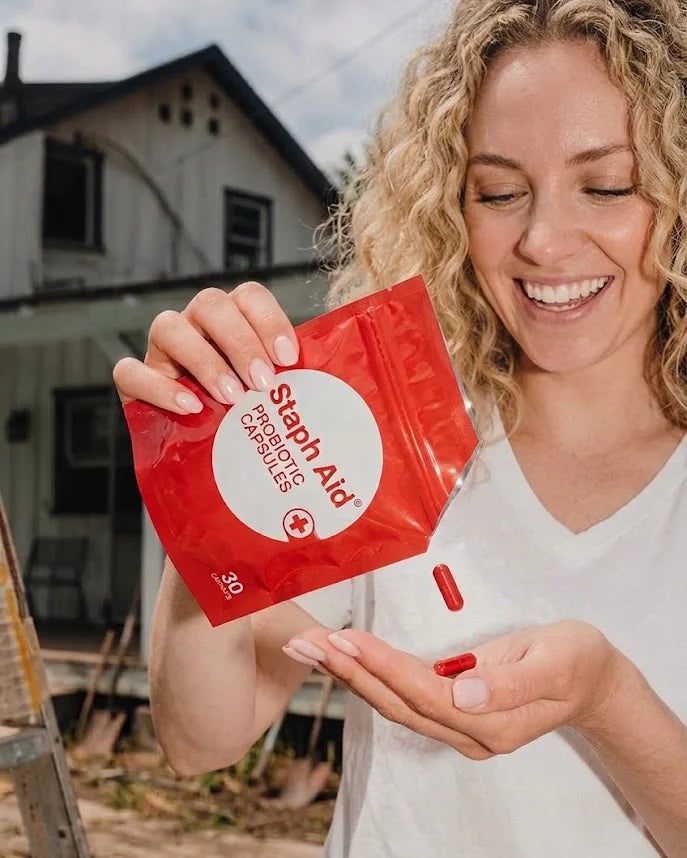
StaphAid is one capsule a day of our proprietary probiotic formula with Vitamin C, formulated to support skin, gut and immune health.* It is not a treatment for any infection.
Learn about StaphAidHugs, beds and everyday contact
People often worry about everyday closeness at home. The main idea is simple: keep the wound fully covered and keep hands clean, and most normal routines can go on. The CDC’s school guidance reflects the same thinking.5
A few things deserve extra care. Towels, washcloths and bedding touch skin for long stretches, so give the person their own and wash them often. Because MRSA can survive on surfaces for days or even weeks, wipe down the things hands touch most, like faucets, light switches and remotes, with a disinfectant labeled for MRSA.4
School, work and sports
Most students with MRSA can go to school as long as they can keep up good hygiene and keep any wound covered.5 Schools usually don’t need to close; routine cleaning is enough in most cases.5
At the gym, keep any wound covered and put a towel or clothing between your skin and shared benches and mats.4 Wipe down equipment before and after you use it, and shower soon after your workout.
Adults should ask their doctor about work, especially jobs with close contact, like healthcare or childcare. Athletes should check with a doctor before returning to contact sports. Our guide to MRSA in team sports covers this in more detail.
How to avoid passing it on
- Keep cuts, scrapes and sores clean and covered until they heal.4
- Wash your hands often, and always after touching a wound or bandage.4
- Don’t pick at or pop sores.4
- Shower soon after exercise or sports.4
- Throw used bandages away in the regular trash.4
- Don’t share towels, washcloths or razors.4
- Put a towel or clothing between your skin and shared surfaces.4
If someone at home has MRSA, see MRSA at home for cleaning and laundry tips.
When to see a doctor
Contact a doctor if you or someone close to you has:
- A red, swollen, painful or warm bump, or one full of pus2
- A skin infection with a fever2
- A sore that isn’t improving within 48 hours2
- Infections that keep coming back or spreading through the household
Get urgent care or call 911 for a fever with fast-spreading redness, confusion, trouble breathing, or feeling very unwell.
Until you are seen, cover the area with clean, dry bandages, don’t pick at or pop the sore, and clean your hands often.2 Those same steps protect the people around you while you wait for answers.
- Cleveland Clinic. MRSA (Methicillin-Resistant Staphylococcus Aureus). https://my.clevelandclinic.org/health/diseases/11633-methicillin-resistant-staphylococcus-aureus-mrsa
- Centers for Disease Control and Prevention. Methicillin-resistant Staphylococcus aureus (MRSA) Basics. https://www.cdc.gov/mrsa/about/index.html
- Centers for Disease Control and Prevention. Clinical Overview of MRSA. https://www.cdc.gov/mrsa/hcp/clinical-overview/index.html
- Centers for Disease Control and Prevention. Preventing MRSA Infections. https://www.cdc.gov/mrsa/prevention/index.html
- Centers for Disease Control and Prevention. Preventing MRSA in Schools and Daycares. https://www.cdc.gov/mrsa/prevention/schools-and-daycares.html
- Scanvic A, et al. Duration of colonization by methicillin-resistant Staphylococcus aureus after hospital discharge and risk factors for prolonged carriage. Clinical Infectious Diseases, 2001;32(10):1393-1398. https://academic.oup.com/cid/article-abstract/32/10/1393/465089
This article is for general education and is not medical advice. If you think you have an infection, see a doctor. These statements have not been evaluated by the Food and Drug Administration. This product is not intended to diagnose, treat, cure, or prevent any disease.