
Nurses and MRSA: Protecting Yourself and Your Family After a Shift
Most nurses don’t carry MRSA, and carrying it isn’t the same as being sick. A few steady habits at work and at the door keep the odds low.
- In a large review, about 4.6% of screened healthcare workers carried MRSA. Most don’t, and carrying it isn’t the same as having an infection.2
- In healthcare, MRSA usually spreads through contact with infected wounds or on contaminated hands.1
- Gloves don’t replace hand hygiene. Clean your hands before putting gloves on and right after taking them off.3
- Scrubs pick up bacteria during a shift. Washing them hot, with bleach if the fabric allows, then machine-drying is the preferred home method.5
What the risk really looks like
Nurses spend their days close to people who may carry MRSA, so it’s fair to wonder what comes home with you. The CDC estimates that about 2 in 100 people carry MRSA, and notes the rate can be higher in some groups.1
Healthcare workers are one of those groups, but not by as much as many people fear. A review that pooled screening results from more than 33,000 healthcare workers found an average MRSA carriage rate of 4.6%.2 So most nurses don’t carry it. And carrying MRSA on your skin or in your nose, called colonization, is not the same as having an infection.
Your hands do most of the work
In healthcare settings, MRSA usually spreads through direct contact with an infected wound or on contaminated hands.1 The review’s authors concluded that healthcare workers most often act as carriers passing germs along, rather than as the original source, and that good hand hygiene remains essential.2
That’s why the CDC’s hand hygiene moments matter so much. Clean your hands right before touching a patient, before a clean or aseptic task, after touching a patient or their surroundings, after contact with body fluids, and right after taking off gloves.3 Some providers clean their hands as often as 100 times in a shift.3
Unless your hands are visibly soiled, alcohol-based hand sanitizer is the preferred choice in most clinical situations, because it kills germs on hands more effectively than soap.3 Switch to soap and water when your hands are visibly dirty.3
Gloves are not a substitute for hand hygiene. Clean your hands before you put gloves on and again after you take them off.3
Look after your own skin
Your skin is your first barrier. In the same review, chronic skin disease was one of the main risk factors for MRSA carriage among healthcare workers.2 Constant hand cleaning can leave skin dry and cracked, so skin care is part of infection control, not a luxury.
- Use a hand lotion your facility approves, so it won’t interfere with hand sanitizer.3
- Avoid hot water when you wash, and pat your hands dry instead of rubbing.3
- Keep natural nails short, no longer than your fingertip. Skip artificial nails if you care for high-risk patients.3
- Cover any cut or scrape, and talk to employee health if your hands crack or develop a rash.

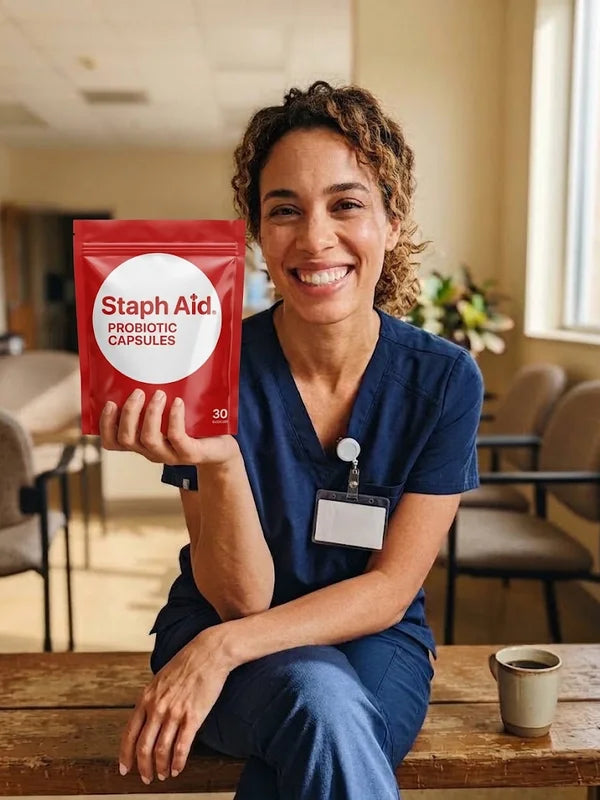
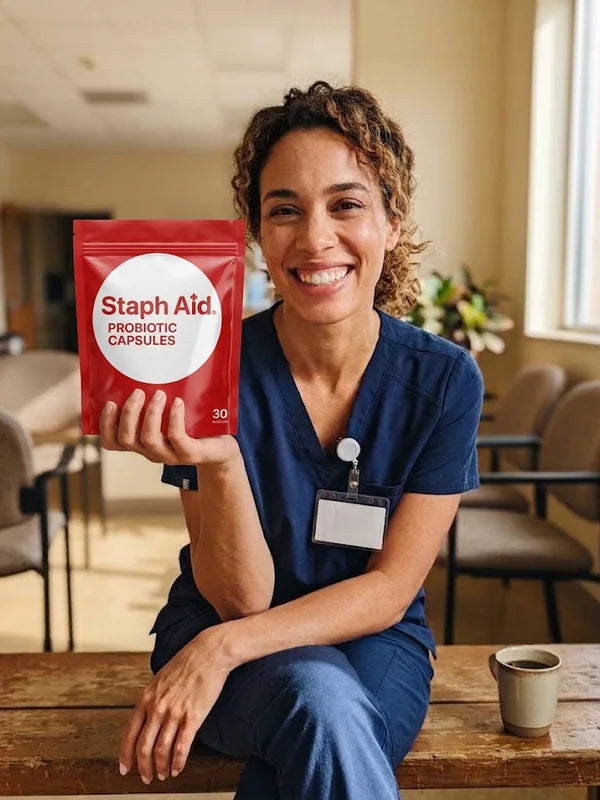
StaphAid is one capsule a day of our proprietary probiotic formula with Vitamin C, formulated to support skin, gut and immune health.* It is not a treatment for any infection.
Learn about StaphAidAn after-shift routine
Your clothes pick things up too. In a trial that followed 40 nurses over 12-hour shifts, their clothing picked up new bacteria during 16% of shifts, and scrubs treated with antimicrobial fabric made no difference.4 Expert guidance notes that all kinds of work clothing can become contaminated, though no clinical study has shown clothing passing infections to patients.5
A short routine covers the basics:
- Clean your hands as you leave the unit, and again when you get home.
- Change out of scrubs at work if you can, and carry them home in a separate bag.
- Wash scrubs in hot water, with bleach if the fabric allows, then dry them in the dryer.5
- Wipe down your phone, badge and water bottle with a product that’s safe for them.
For the research on clothing, read Do Scrubs Carry Germs Home?
At home with your family
Outside the hospital, MRSA spreads the same basic way: through contact with infected skin or wounds, or with things that have touched infected skin.6 That means the everyday rules that protect any household also protect your family from anything you might bring home.
- Keep towels, razors and washcloths personal.
- Cover any cut or scrape until it heals.
- Wash hands before cooking and eating, and after dressing changes.
- If anyone at home gets boils or skin infections that keep coming back, tell their doctor that someone in the house works in healthcare.
If you’re curious whether you carry staph, it’s worth knowing that carriage is common in everyone, not just nurses. Our article on why carriage is common among healthcare workers explains more.
When to see a doctor
See a doctor, and let employee health know, if you or someone at home has:
- A bump or sore that is red, swollen, warm, painful or draining pus6
- A skin infection with a fever6
- A skin infection that isn’t improving within 48 hours6
- Boils or skin infections that keep coming back
Get urgent care or call 911 for fever with fast-spreading redness, confusion or trouble breathing. Don’t squeeze a sore; keep it covered and let a doctor decide on treatment.6 Check your facility’s policy before working with a draining skin infection.
- Centers for Disease Control and Prevention. Clinical Overview of Methicillin-resistant Staphylococcus aureus (MRSA) in Healthcare Settings. https://www.cdc.gov/mrsa/hcp/clinical-overview/index.html
- Albrich WC, Harbarth S. Health-care workers: source, vector, or victim of MRSA? The Lancet Infectious Diseases. 2008;8(5):289–301. https://pubmed.ncbi.nlm.nih.gov/18471774/
- Centers for Disease Control and Prevention. Clinical Safety: Hand Hygiene for Healthcare Workers. https://www.cdc.gov/clean-hands/hcp/clinical-safety/index.html
- Anderson DJ, Addison R, Lokhnygina Y, et al. The Antimicrobial Scrub Contamination and Transmission (ASCOT) Trial: a three-arm, blinded, randomized controlled trial with crossover design to determine the efficacy of antimicrobial-impregnated scrubs in preventing healthcare provider contamination. Infection Control & Hospital Epidemiology. 2017;38(10):1147–1154. https://doi.org/10.1017/ice.2017.181
- Bearman G, Bryant K, Leekha S, et al. Healthcare personnel attire in non-operating-room settings. Infection Control & Hospital Epidemiology. 2014;35(2):107–121. https://doi.org/10.1086/675066
- Centers for Disease Control and Prevention. Methicillin-resistant Staphylococcus aureus (MRSA) Basics. https://www.cdc.gov/mrsa/about/index.html
This article is for general education and is not medical advice. If you think you have an infection, see a doctor. These statements have not been evaluated by the Food and Drug Administration. This product is not intended to diagnose, treat, cure, or prevent any disease.