
Do Scrubs Carry Germs Home? What the Research Says
Studies find that scrubs pick up bacteria, staph included, during a shift. Here’s what that means, what it doesn’t, and how to wash them at home.
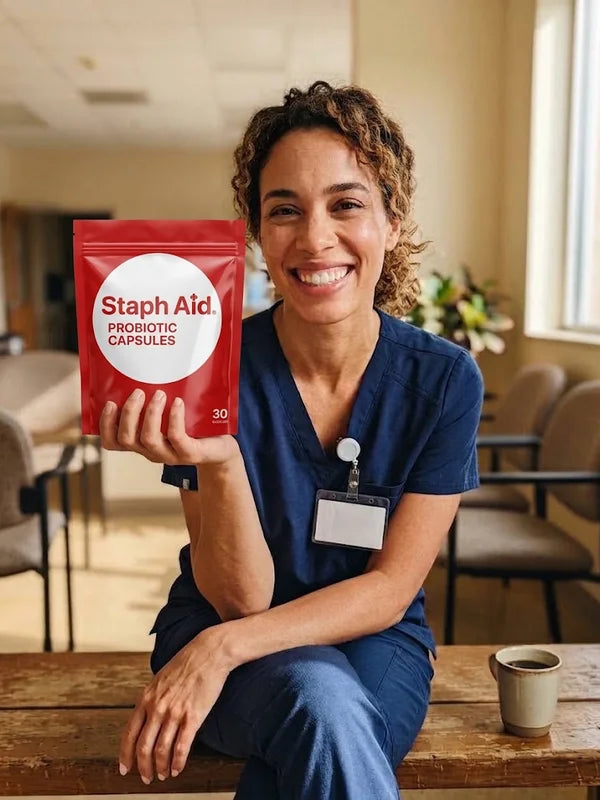
- Scrubs, white coats and other work clothing often pick up bacteria during a shift, including staph and sometimes MRSA.5
- No clinical study has shown that germs on clothing pass infections from a healthcare worker to a patient.5
- In a trial, antimicrobial scrubs did no better than regular scrubs at staying clean.3
- If you wash scrubs at home, expert guidance prefers a hot wash, ideally with bleach, followed by the dryer.5
The short answer
Yes, scrubs pick up bacteria during a shift. Expert guidance from the Society for Healthcare Epidemiology of America (SHEA) reviewed the research and found that every type of work clothing studied, from scrubs to neckties to white coats, can become contaminated with germs such as Staphylococcus aureus and MRSA.5
What research hasn’t shown is that those germs on clothing cause infections. The same guidance notes that no clinical study has shown a healthcare worker’s clothing passing germs on to a patient.5 So contaminated scrubs are a reason for good habits, not for alarm.
What the studies found
A few studies give a sense of how common contamination is:
- Uniforms at the end of the day. In a 2011 study of 135 nurses and doctors, more than 60% of uniforms grew potentially harmful bacteria: 65% of nurses’ and 60% of doctors’. Eight of the cultures grew MRSA.1
- Scrubs in intensive care. A study that took 720 samples from the scrubs of 90 critical-care workers found disease-causing bacteria on 30% of them. Caring for patients with wounds was linked to higher odds of contamination.2
- New germs during a single shift. A trial that followed 40 nurses through 12-hour shifts found their clothing picked up new disease-causing bacteria during 16% of shifts, and the hospital room itself was a key source.3
- Coats and ties. A 2021 review of 23 studies found MRSA on up to 79% of long-sleeved white coats and up to 32% of ties in some studies.4
These studies measured bacteria on fabric. None of them measured whether nurses’ or doctors’ families got sick.
Where the germs come from
Clothing picks up germs the same way hands do: through contact. In the intensive-care study, caring for patients with wounds raised the odds that scrubs were contaminated, and giving patients a bath may also play a part.2 Scrubs were less contaminated when workers were caring for at least one patient on contact precautions, where gowns and gloves are worn over clothing.2
Patients aren’t the only source. In the 40-nurse trial, the hospital room itself was an important source of the new bacteria on nurses’ clothing.3 Bed rails, carts and other surfaces near the patient all count. That’s why wearing a gown when your workplace calls for one, and keeping your sleeves and front away from surfaces, are sensible habits.
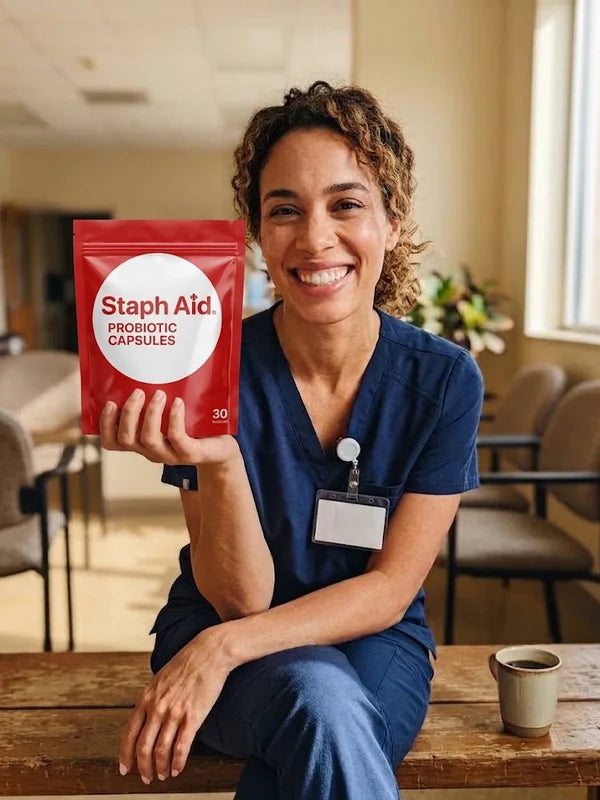
StaphAid is one capsule a day of our proprietary probiotic formula with Vitamin C, formulated to support skin, gut and immune health.* It is not a treatment for any infection.
Learn about StaphAidDo antimicrobial scrubs help?
Scrubs made with antimicrobial fabric are marketed as a fix. The best test so far didn’t find a benefit. In the trial of 40 nurses, researchers compared two kinds of antimicrobial scrubs with standard scrubs, and the type of scrub made no difference to how often clothing became contaminated.3
Fabric can’t replace the basics. Clean hands, and a clean set of scrubs each shift, do more than any special material.
How to wash scrubs at home
Many healthcare workers wash their own scrubs. SHEA’s guidance says that when work clothing is laundered at home, a hot water wash, ideally with bleach, followed by a cycle in the dryer is preferable.5
- Check the care label first. Use bleach only if the fabric allows it.
- Use the hottest water the fabric can take, and dry scrubs fully in the dryer.5
- Wear a clean set every shift. If you wear a white coat, keep at least two so one can be in the wash.5
- If your workplace offers hospital-laundered scrubs, use them. The 2021 review favored in-house laundering as part of reducing MRSA on clothing.4
Our guide to laundry and staph covers towels and bedding too.
Habits that help
Most of what keeps germs from traveling is simple and routine:
- Change out of scrubs before you leave work if you can, and bring them home in a separate bag.
- Follow your facility’s policy on wearing scrubs outside work.
- Clean your hands when you leave, and again when you get home.
- Wash scrubs soon, rather than leaving them in a pile with other clothes.
- Remember the other things that travel with you, like your phone, badge and stethoscope.
For a full routine, see Nurses and MRSA: protecting yourself and your family after a shift.
When to see a doctor
Clothing is rarely the problem, but skin infections still happen. See a doctor if you or someone at home has:
- A bump or sore that is red, swollen, warm, painful or full of pus6
- A skin infection with a fever6
- A skin infection that doesn’t improve within 48 hours6
- Skin infections that keep coming back
Get urgent care or call 911 for fever with fast-spreading redness, confusion or trouble breathing. Keep sores covered and don’t squeeze them.6
- Wiener-Well Y, et al. Nursing and physician attire as possible source of nosocomial infections. American Journal of Infection Control. 2011;39(7):555. https://pubmed.ncbi.nlm.nih.gov/21864762/
- Thom KA, Escobar D, Boutin MA, Zhan M, Harris AD, Johnson JK. Frequent contamination of nursing scrubs is associated with specific care activities. American Journal of Infection Control. 2018;46(5):503–506. https://pubmed.ncbi.nlm.nih.gov/29336847/
- Anderson DJ, Addison R, Lokhnygina Y, et al. The Antimicrobial Scrub Contamination and Transmission (ASCOT) Trial: a three-arm, blinded, randomized controlled trial with crossover design to determine the efficacy of antimicrobial-impregnated scrubs in preventing healthcare provider contamination. Infection Control & Hospital Epidemiology. 2017;38(10):1147–1154. https://doi.org/10.1017/ice.2017.181
- Lena P, Ishak A, Karageorgos SA, Tsioutis C. Presence of methicillin-resistant Staphylococcus aureus (MRSA) on healthcare workers’ attire: a systematic review. Tropical Medicine and Infectious Disease. 2021;6(2):42. https://pmc.ncbi.nlm.nih.gov/articles/PMC8103237/
- Bearman G, Bryant K, Leekha S, et al. Healthcare personnel attire in non-operating-room settings. Infection Control & Hospital Epidemiology. 2014;35(2):107–121. https://doi.org/10.1086/675066
- Centers for Disease Control and Prevention. Methicillin-resistant Staphylococcus aureus (MRSA) Basics. https://www.cdc.gov/mrsa/about/index.html
This article is for general education and is not medical advice. If you think you have an infection, see a doctor. These statements have not been evaluated by the Food and Drug Administration. This product is not intended to diagnose, treat, cure, or prevent any disease.