
Laundry and Staph: How to Wash Towels, Sheets and Clothes
Staph can live on fabric, and towels are easy to share. Here’s how to handle, wash and dry laundry when someone at home has a staph or MRSA infection.
- Wash towels, sheets and clothes that touched an infected area in hot water, following the care label.
- Dry laundry all the way in a hot dryer, not on a line.
- Carry dirty laundry gently, and wash your hands after handling it.
- Everyone at home should have their own towels and washcloths while an infection heals.
The short answer
Everyday washing with detergent handles most laundry just fine. When someone at home has a staph or MRSA skin infection, a few extra steps help: hot water where the fabric allows, a full cycle in a hot dryer, careful handling, and no shared towels.
Why bother? MRSA can survive on some surfaces for hours, days or even weeks, and it can cause an infection if it reaches a cut or scrape.1 Towels, washcloths and bedding touch skin all day, so they are worth a little extra care.
Handling dirty laundry
Germs can move from laundry to hands before anything goes in the machine. A few habits keep that in check:
- Carry dirty items gently, and don’t shake them out. Hospital guidelines call for handling soiled linen with as little shaking as possible so germs don’t spread on lint.2
- Hold laundry away from your body, and use a hamper or a washable bag instead of your arms. Wash the bag with the load.
- Keep dirty laundry off beds and couches.
- Wash your hands after handling dirty clothes.3
Washing: water, detergent and bleach
MedlinePlus advises washing clothes, washcloths, towels and sheets that touched an infected area in hot water.4 For soiled sheets, towels and clothes, it also suggests adding bleach and drying in a hot dryer.5 Always check the care label first, since not every fabric can take hot water or bleach. The CDC also points to the maker’s instructions.3
If you use bleach, choose one made for laundry, follow the label, and never mix it with other cleaning products.
Hospitals have stricter rules: hot-water washing at 160°F (71°C) or higher for at least 25 minutes is a common standard.2 Home washers work differently, but the washing itself still does a lot. Water and agitation carry away large numbers of germs.2
The washer isn’t a perfect filter, though. One study of home washing machines found that bacteria move between garments during a cycle, and it cited earlier work showing staph can survive wash programs at 50°C (122°F).6 That is a good reason to wash the towels and bedding of someone with an active infection in their own load.
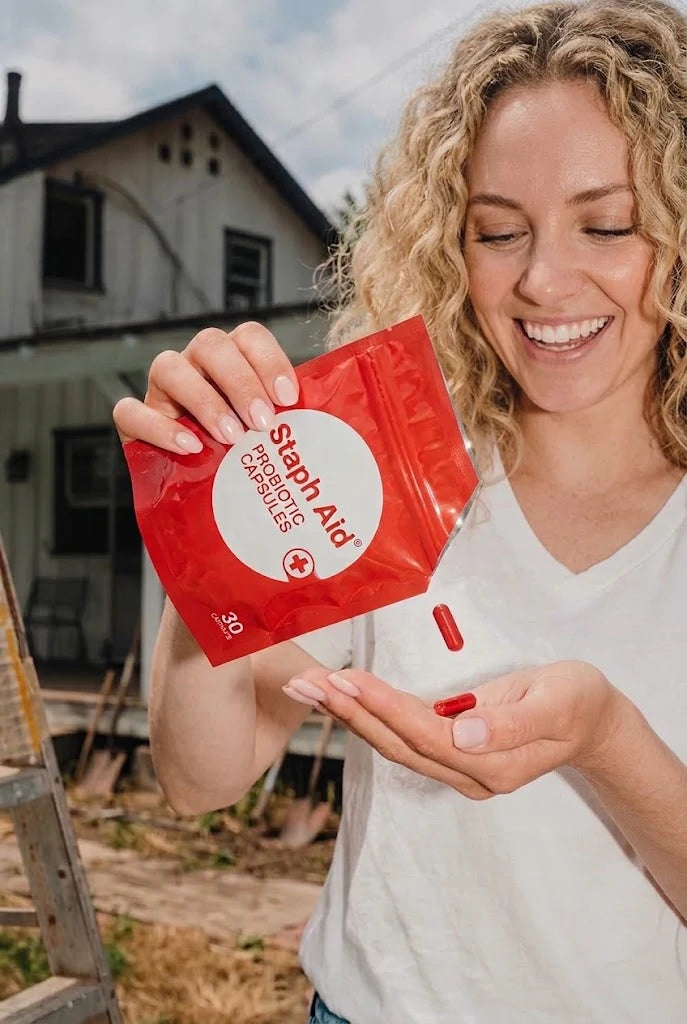
StaphAid is one capsule a day of our proprietary probiotic formula with Vitamin C, formulated to support skin, gut and immune health.* It is not a treatment for any infection.
Learn about StaphAidDrying: go all the way
Drying is part of cleaning, not an afterthought. For athletes, the CDC recommends washing uniforms, towels and clothes after each use and drying them completely in a dryer rather than hanging them to air-dry.3 The same idea works at home.
- Use the hottest dryer setting the care label allows.5
- Run the full cycle until everything is dry all the way through, including thick seams and towel edges.
- Don’t leave wet laundry sitting in the washer or in a damp pile.
Towels, sheets and what not to share
Sharing is where laundry and staph most often meet. MedlinePlus advises against reusing or sharing washcloths or towels.4 The CDC’s list of items not to share includes towels, washcloths, razors and clothing, including sports uniforms.3
- Give each person their own bath towel, hand towel and washcloth.
- Use a fresh towel after each shower while an infection is healing.4
- Change and wash sheets and pillowcases often during that time.
- Wash gym clothes, uniforms and workout towels after every use.3
Athletes and gym-goers can find more in what athletes shouldn’t share.
Special cases
Work uniforms. CDC guidelines note that uniforms without blood or body fluids on them aren’t very different from street clothes, and home washing handles that level of soiling.2 For items with visible blood or wound drainage, follow your employer’s rules.
Sports gear. Pads, gloves and bags that can’t go in the washer should be cleaned following the maker’s instructions.3 Wipe down anything that touches bare skin, and let it dry fully before the next use.
Blankets, pillows and bulky items. If the care label allows hot water and a hot dryer, treat them like sheets. If not, use the warmest setting the label allows and make sure they dry all the way through.
Laundromats and shared machines. Carry dirty items in a bag you can wash, keep clean and dirty loads apart, and fold clean laundry on a clean surface.
When to see a doctor
Clean laundry helps keep staph from spreading, but it doesn’t heal an infection. Contact a doctor if you or someone at home has:
- A bump or sore that is red, swollen, painful or warm to the touch
- Pus or other drainage from a sore
- A fever along with a skin infection
- Skin infections that keep coming back or spreading to others in the home
Get urgent care or call 911 for a fever with fast-spreading redness, confusion or trouble breathing. For the bigger picture on keeping a home safe, see MRSA at home.
- Centers for Disease Control and Prevention. Preventing MRSA Infections. https://www.cdc.gov/mrsa/prevention/index.html
- Centers for Disease Control and Prevention. Guidelines for Environmental Infection Control in Health-Care Facilities: Laundry and Bedding. https://www.cdc.gov/infection-control/hcp/environmental-control/laundry-bedding.html
- Centers for Disease Control and Prevention. Preventing MRSA Infections in Athletes. https://www.cdc.gov/mrsa/prevention/athletes.html
- MedlinePlus Medical Encyclopedia. Staph infections - self-care at home. https://medlineplus.gov/ency/patientinstructions/000686.htm
- MedlinePlus. MRSA. https://medlineplus.gov/mrsa.html
- Callewaert C, et al. Bacterial exchange in household washing machines. Frontiers in Microbiology, 2015;6:1381. https://www.frontiersin.org/journals/microbiology/articles/10.3389/fmicb.2015.01381/full
This article is for general education and is not medical advice. If you think you have an infection, see a doctor. These statements have not been evaluated by the Food and Drug Administration. This product is not intended to diagnose, treat, cure, or prevent any disease.