
Is Staph Contagious? How It Spreads and How Long It Lasts
Yes, staph spreads, but catching it is not the same as getting sick. Here’s how it passes between people, how long it stays catching, and how to stop it at home.

- Yes. Staph spreads through skin contact and on things that touch skin, like towels, razors and clothing.2
- About 1 in 3 people carry staph in their nose, and people who carry it without symptoms can still pass it on.1
- There’s no set countdown. Pus from an infected sore can carry the germ, so keep wounds covered until they heal.6
- Most people with a covered skin infection can keep going to school or work unless their doctor says otherwise.5
The short answer
Yes, staph is contagious. Staphylococcus aureus passes from person to person through skin contact, and it can also travel on objects like towels, clothing, door handles, sports gear and TV remotes.2
But being exposed to staph is not the same as getting sick. Staph is one of the most common germs on the human body, and it usually lives on skin or in the nose without causing any trouble. An infection starts when staph gets inside, most often through a cut, scrape or other break in the skin.2
So the useful question isn’t only whether staph spreads. It’s how to keep it away from broken skin, and the good news is that the steps are simple.
How staph spreads
Staph moves in a few everyday ways:
- Skin-to-skin contact, especially touching an infected sore or wound.
- Shared personal items such as towels, washcloths, razors, clothing and uniforms.6
- Surfaces that many hands touch. The CDC notes that MRSA, a type of staph, can survive on some surfaces for hours, days or even weeks.4
- Hands that touch a wound or a contaminated item and then touch someone else.
Pus from an infected wound can contain staph, so an open, draining sore is one of the easiest ways for it to spread.6 For a closer look at each route, read how people get staph.
You can spread staph without feeling sick
About 1 in 3 people carry staph in their nose, and about 2 in 100 carry MRSA.1 Most of them have no idea. Carrying staph without symptoms is called being “colonized”, and it doesn’t hurt, itch or show.
People who are colonized can still pass the germ to others.1 That isn’t a reason to fear every handshake. It’s a reason to make a few simple habits, like handwashing and not sharing razors, normal for everyone in a household. Learn more about what it means to be a carrier.

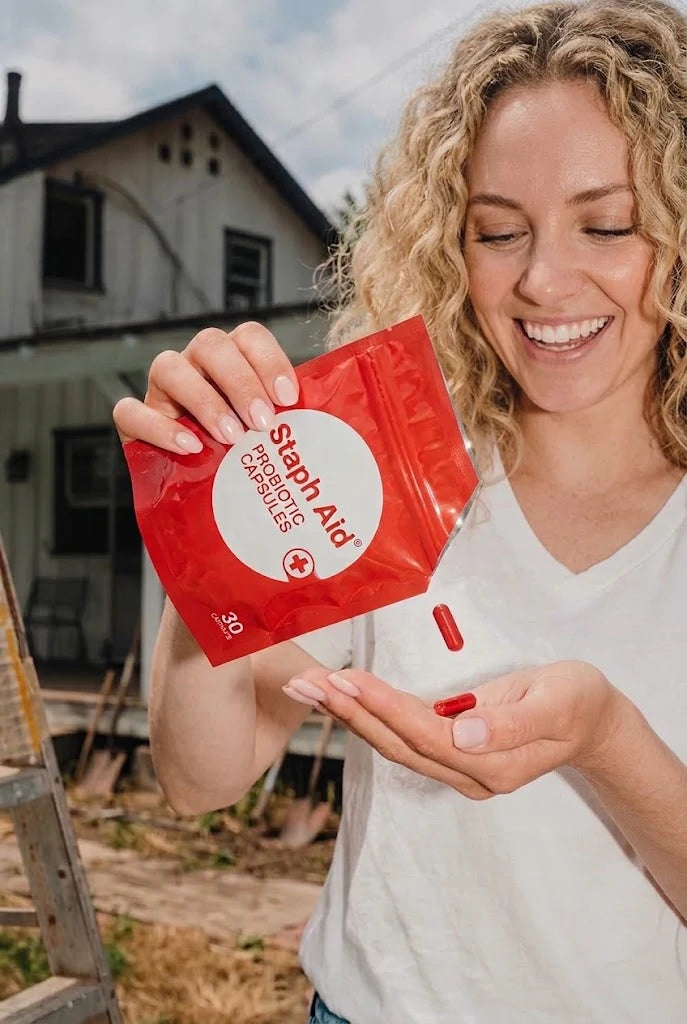
StaphAid is one capsule a day of our proprietary probiotic formula with Vitamin C, formulated to support skin, gut and immune health.* It is not a treatment for any infection.
Learn about StaphAidHow long is staph contagious?
There isn’t a set number of days. Staph can spread for as long as it is on your skin or in your body, and doctors use a nose or skin swab to check for it.3
In daily life, the riskiest stretch is while a sore is open or draining. Once the skin has fully healed, there’s no open wound left to spread from. Keep in mind that someone can still carry staph on their skin or in their nose after an infection clears, and can still pass it on.3 That’s why good habits matter even after the sore is gone.
School, work and sports
Most people don’t need to stay home. The CDC says most students with MRSA skin infections can go to school unless a healthcare provider says otherwise. Staying home makes sense when a wound is draining and can’t be kept covered, or when someone can’t keep up with basic hygiene.5
Schools usually don’t need to close or deep-clean after a single case, and they generally don’t need to alert every family about one infection. Routine cleaning is enough in most cases.5
Sports are different because of all the skin contact. If you have an open wound, stay out of whirlpools, therapy pools and swimming pools until it heals, and ask your doctor when it’s safe to return to contact sports.6
Keeping it from spreading at home
If someone in your home has a staph skin infection, a few steady habits help protect everyone else. None of them need special products.
- Cover cuts, scrapes and sores with clean, dry bandages until they heal.6
- Don’t pick at or pop sores.4
- Wash your hands often, and always after changing a bandage or touching a wound.6
- Follow your doctor’s directions for how often to change bandages.6
- Shower after workouts, and don’t share bar soap.6
- Don’t share towels, washcloths, razors, clothing or ointments from open containers.6
- Wash towels and clothes after each use and dry them completely in a dryer.6
- Clean surfaces people touch often, following the directions on the product label.4
When to see a doctor
Call a doctor if you or someone you live with has:
- A bump or sore that is red, swollen, warm, painful or full of pus4
- A skin infection along with a fever4
- Redness that is spreading, or a sore that isn’t getting better
- Skin infections that keep coming back, in one person or several people at home
Get urgent care or call 911 for a fever with fast-spreading redness, confusion, trouble breathing, or a baby who seems very sick.
A doctor can test the infection and decide on the right treatment, so skip the home remedies. The habits above are simple, cost almost nothing, and help protect everyone under your roof.
- Centers for Disease Control and Prevention. Clinical Overview of Methicillin-resistant Staphylococcus aureus (MRSA) in Healthcare Settings. https://www.cdc.gov/mrsa/hcp/clinical-overview/index.html
- MedlinePlus, National Library of Medicine. Staphylococcal Infections. https://medlineplus.gov/staphylococcalinfections.html
- Cleveland Clinic. MRSA (Methicillin-Resistant Staphylococcus Aureus). https://my.clevelandclinic.org/health/diseases/11633-methicillin-resistant-staphylococcus-aureus-mrsa
- Centers for Disease Control and Prevention. Preventing Methicillin-resistant Staphylococcus aureus (MRSA). https://www.cdc.gov/mrsa/prevention/index.html
- Centers for Disease Control and Prevention. Schools and Daycares: MRSA Prevention and Response. https://www.cdc.gov/mrsa/prevention/schools-and-daycares.html
- Centers for Disease Control and Prevention. Athletes: MRSA Prevention and Control. https://www.cdc.gov/mrsa/prevention/athletes.html
This article is for general education and is not medical advice. If you think you have an infection, see a doctor. These statements have not been evaluated by the Food and Drug Administration. This product is not intended to diagnose, treat, cure, or prevent any disease.