
Towels, Razors and Water Bottles: What Athletes Shouldn’t Share
Teammates share a lot, but some things should stay personal. Here’s the short list of items that can pass staph, ringworm and other germs around a team.
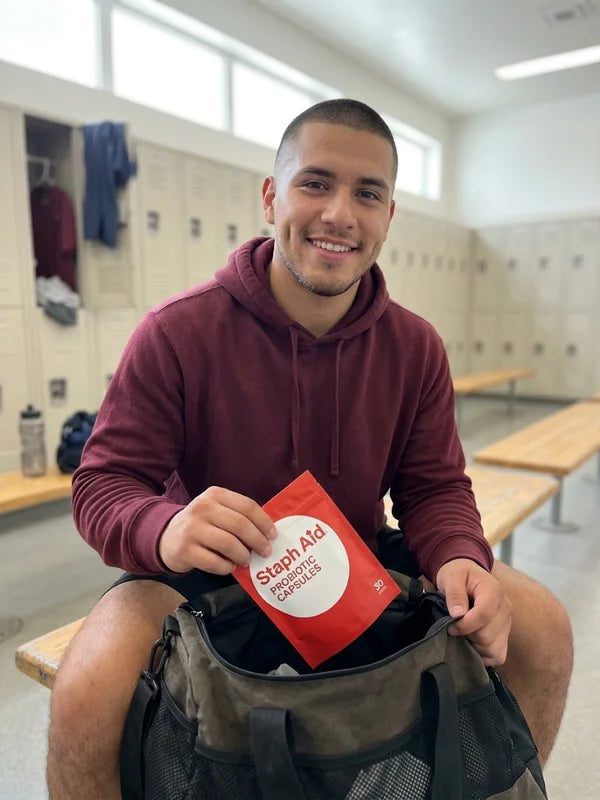
- The CDC advises athletes not to share towels, washcloths, razors, clothing, uniforms or ointments from open containers.1
- Shared bar soap and towels were linked to MRSA in a college football outbreak.2
- Keep your water bottle to yourself. Some viruses spread through saliva.5
- For gear you can’t avoid sharing, clean it and put a barrier between it and your skin.1
The short list
Keep these to yourself: towels, washcloths, razors, clothing, uniforms and ointments from open containers. That’s the CDC’s list for athletes.1 Add bar soap and your water bottle, for reasons you’ll see below.
The reason is simple. Staph and MRSA spread through skin-to-skin contact and by touching surfaces and objects that carry the bacteria.1 Anything that touches one person’s skin and then another’s can carry germs between them.
You also can’t tell by looking who is carrying germs. A teammate can feel fine and look fine, so the safest rule is the same for everyone, including your best friend on the team.
Towels and bar soap
Towels are the classic shared item, and they have a track record. In a CDC investigation of repeat MRSA infections on a college football team, sharing bars of soap was a major risk factor for infection, and players who carried MRSA were far more likely to have shared towels with teammates.2 The investigators recommended switching to liquid soap.2
Towels spread more than bacteria. Ringworm, a fungal skin infection, also passes through shared towels and bedsheets.4 Bring your own towel, use it once, and wash it. On the sideline or at the pool, the same rule applies: one towel per person.
Razors, balms and ointments
Razors scrape skin and can cause tiny nicks you can’t see. Sharing one is a direct route from one person’s skin to another’s open skin. The CDC includes razors on its do-not-share list for athletes.1
If you shave, use your own razor and don’t leave it in a shared bin. In one college football outbreak, shaving itself was named as a possible risk factor, because of the skin damage it can cause.3
A tub of balm passed around the bench collects a little of everyone’s fingers. The CDC specifically warns against sharing ointments from open containers.1 In a 2003 CDC report on MRSA among athletes, football players had shared lubricants and unwashed towels.3
Use your own tube or pump, and keep it in your own bag.
StaphAid is one capsule a day of our proprietary probiotic formula with Vitamin C, formulated to support skin, gut and immune health.* It is not a treatment for any infection.
Learn about StaphAidWater bottles and anything that touches your mouth
Staph isn’t the only reason to keep your bottle to yourself. Mono spreads mostly through saliva, and the CDC advises against sharing drinks with someone who has it.5 Mono also matters for athletes because it can enlarge the spleen, so people with mono should avoid contact sports until they’ve fully recovered.5
Herpes gladiatorum, a skin infection caused by herpes simplex virus type 1, spreads through sores and through shared equipment, towels and personal items.6 Make it a team rule: your bottle, your mouthguard, your gear.
At games and tournaments, fill your own bottle before you leave home, and skip shared coolers where people dip in their own cups.
Gear you can’t avoid sharing
Mats, benches, weights and pads get shared by design. In one outbreak on a fencing club, athletes shared sensor wires that had no cleaning schedule.3 For shared gear:
- Wipe it down before and after you use it, if your gym provides wipes or spray.
- Keep the gear you wear, like headgear, pads and gloves, to yourself when you can.
- Put a towel or clothing between your skin and shared surfaces like benches and saunas.1
- Wash and fully dry your uniform after each use.1
- Wash your hands before and after using shared equipment.1
See staph at the gym for more on shared equipment.
Making it a team habit
Habits stick best when the whole team does them. Coaches and parents can make the easy choice the default:
- Put names on water bottles, towels and gear bags.
- Stock showers and sinks with liquid soap instead of shared bars.2
- Keep alcohol-based hand sanitizer handy for when soap and water aren’t available.1
- Remind athletes to shower right after practice and to wash their uniform after each use.1
- Make it normal to tell a coach or trainer about a skin problem right away.1
None of this is about suspecting teammates. It’s about keeping everyone healthy enough to play.
When to see a doctor
Tell your coach or athletic trainer right away about any skin problem, and see a doctor if you notice:1
- A bump or sore that is red, swollen, warm, painful or full of pus
- Redness that is spreading, or red streaks moving away from a cut
- Fever or chills with a skin problem
- A cluster of blisters or a ring-shaped rash
If you have a fever with fast-spreading redness or feel very ill, get urgent care or call 911. Don’t squeeze or drain a bump, and don’t try to treat it at home.
- Centers for Disease Control and Prevention. Athletes: MRSA Prevention and Control. https://www.cdc.gov/mrsa/prevention/athletes.html
- Nguyen DM, et al. Recurring methicillin-resistant Staphylococcus aureus infections in a football team. Emerging Infectious Diseases, 2005;11(4). https://wwwnc.cdc.gov/eid/article/11/4/04-1094_article
- Centers for Disease Control and Prevention. Methicillin-Resistant Staphylococcus aureus Infections Among Competitive Sports Participants: Colorado, Indiana, Pennsylvania, and Los Angeles County, 2000–2003. MMWR, 2003;52(33). https://www.cdc.gov/mmwr/preview/mmwrhtml/mm5233a4.htm
- Centers for Disease Control and Prevention. Ringworm Basics. https://www.cdc.gov/ringworm/about/index.html
- Centers for Disease Control and Prevention. About Infectious Mononucleosis. https://www.cdc.gov/epstein-barr/about/mononucleosis.html
- Wisconsin Department of Health Services. Herpes Gladiatorum. https://www.dhs.wisconsin.gov/disease/herpes-gladiatorum.htm
This article is for general education and is not medical advice. If you think you have an infection, see a doctor. These statements have not been evaluated by the Food and Drug Administration. This product is not intended to diagnose, treat, cure, or prevent any disease.