
Staph at the Gym: How to Protect Yourself
Sweat, shared benches and small scrapes give staph easy chances at the gym. A few simple habits before, during and after your workout keep the risk low.

- Staph and MRSA spread through contact with infected skin and with things that touched it, like benches and towels.3
- Use a towel as a barrier between your skin and shared equipment, and wipe equipment before and after use.2
- Cover cuts and scrapes with a clean, dry bandage until they heal, and keep them out of pools and hot tubs.1
- Shower soon after exercise, and wash and fully dry your gym clothes and towels after each use.1
How staph spreads at the gym
The gym is a good place for your health, and staph shouldn’t keep you away. It helps to know how it moves. MRSA spreads in the community through contact with infected people, wounds, or things that have touched infected skin, and the CDC lists athletes among the groups at higher risk.3 Most people who work out never get a staph infection, though. The goal is not to avoid equipment. It is to close off the easy routes: skin to shared surface, germ to open cut, and towel to towel.
Gyms bring those pieces together: bare skin on shared benches and mats, sweat, and small scrapes from bars and machines. When the CDC looked into staph outbreaks among sports teams, sharing towels, sharing balms and lotions, and skin injuries all played a part.5
Use a barrier and wipe it down
Anything that touches bare skin is worth a second thought: benches, mats, seats and handles.2 The CDC advises using a barrier, like a towel or clothing, between your skin and shared surfaces.2
- Lay your own towel on benches and mats before you use them.
- Use the gym’s wipes or spray on equipment before and after you use it.
- Wear clothes that cover more skin on machines and mats.
- Wash your hands or use an alcohol-based hand sanitizer after your workout.1
Gyms have a part to play too. The CDC advises facilities to clean shared equipment after each use and let it dry, whether or not anyone has had an infection.4 If the wipe stations are empty, let the staff know. Free weights, yoga mats and the handles on cardio machines are touched by many hands a day, so they deserve the same care. If you do a lot of floor work or stretching, bringing your own mat is an easy upgrade.
Cover cuts and scrapes
Staph gets into the body through broken skin, so a cut, scrape or blister is where you’re most vulnerable. Cover it with a clean, dry bandage until it heals, and wash your hands after changing the bandage.1
If a wound can’t be kept covered, skip mat work and shared equipment until it heals. Stay out of pools, hot tubs and whirlpools if you have an open wound or skin infection, and don’t go back until a healthcare provider says it’s okay.1 Rough spots from turf or mats count too; see turf burns, mat burns and staph.
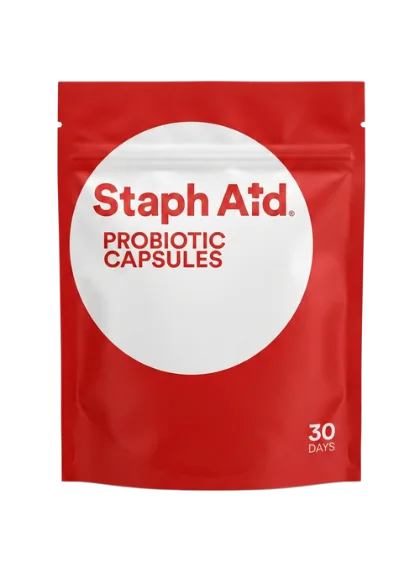
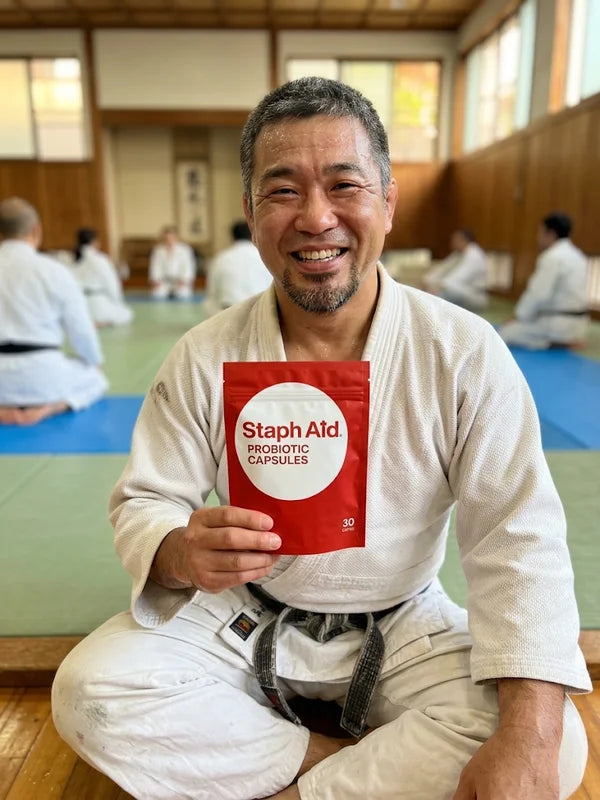
StaphAid is one capsule a day of our proprietary probiotic formula with Vitamin C, formulated to support skin, gut and immune health.* It is not a treatment for any infection.
Learn about StaphAidKeep personal items personal
Some things should never be shared, even with a friend. The CDC lists towels, washcloths, razors, clothing and ointments from open containers.1 Skip shared bar soap, too.1
- Bring your own towel, water bottle and flip-flops for the shower.
- Use pump soap rather than a shared bar.
- Never borrow a razor. Shaving leaves tiny nicks in the skin.
- Keep lotions and ointments in tubes or pumps, not open jars.
For a full list, read what athletes shouldn’t share.
After your workout
- Shower soon after exercise.1
- Shower before using a pool or therapy pool, too.1
- Wash your workout clothes and towels after each use, then dry them completely in a dryer rather than on a line.1
- Don’t leave damp clothes sitting in your gym bag. Empty it when you get home.
If you can’t shower at the gym, change out of sweaty clothes and shower as soon as you get home. These steps take a few minutes and do more than any special product.
What to look for in a gym
A clean gym makes good habits easier. Look for wipe stations that stay stocked, mats and benches that are cleaned regularly, and showers with soap dispensers. It’s fine to ask the staff how often equipment is cleaned and what they use.
The CDC advises facilities to use bleach, a detergent-based cleaner or an EPA-registered disinfectant on surfaces that touch bare skin.4 A gym that can tell you its routine is usually a gym that has one.
When to see a doctor
A staph skin infection can look like a pimple or boil at first. See a healthcare provider if you notice:
- A bump or area that is red, swollen, warm, painful or full of pus3
- A skin infection with a fever3
- A skin problem that doesn’t improve within 48 hours3
- Spreading redness, or red streaks moving away from a wound
Don’t pick at or pop a sore.2 Keep it covered and let a doctor decide on treatment. If you train on a team, tell your coach or athletic trainer right away.1 Get urgent care or call 911 for high fever with fast-spreading redness, confusion or trouble breathing.
- Centers for Disease Control and Prevention. Athletes: MRSA Prevention and Control. https://www.cdc.gov/mrsa/prevention/athletes.html
- Centers for Disease Control and Prevention. Preventing Methicillin-resistant Staphylococcus aureus (MRSA). https://www.cdc.gov/mrsa/prevention/index.html
- Centers for Disease Control and Prevention. Methicillin-resistant Staphylococcus aureus (MRSA) Basics. https://www.cdc.gov/mrsa/about/index.html
- Centers for Disease Control and Prevention. Athletic Facilities: MRSA Prevention and Control. https://www.cdc.gov/mrsa/prevention/coaches-athletic-directors.html
- Centers for Disease Control and Prevention. Methicillin-resistant Staphylococcus aureus infections among competitive sports participants: Colorado, Indiana, Pennsylvania, and Los Angeles County, 2000–2003. MMWR. 2003;52(33). https://www.cdc.gov/mmwr/preview/mmwrhtml/mm5233a4.htm
This article is for general education and is not medical advice. If you think you have an infection, see a doctor. These statements have not been evaluated by the Food and Drug Administration. This product is not intended to diagnose, treat, cure, or prevent any disease.