
Turf Burns, Mat Burns and Staph
A turf or mat burn is an open scrape, and open skin is how staph gets in. Here’s how to clean it, cover it, and know when it needs a doctor.
- Turf burns and mat burns are scrapes. Broken skin gives germs like staph a way in.1
- Clean a fresh burn with water and mild soap, keep it moist and cover it with a clean bandage.3
- Keep it covered during play, and skip whirlpools and pools until it heals.2
- Spreading redness, swelling, pus or fever means it’s time to see a doctor.3,4
What turf burns and mat burns are
A turf burn is the raw scrape you get from sliding on artificial turf. A mat burn is the same kind of injury from friction against a wrestling or gym mat. Despite the name, neither is a heat burn. Friction rubs away the top layer of skin and leaves an open, stinging patch.
Turf burns are common in sports played on artificial fields, like football and soccer. Mat burns show up in wrestling, jiu-jitsu and other mat sports. Either way, you end up with a patch of raw skin that needs protecting until it heals.
They’re a normal part of many sports. The problem isn’t the scrape itself. It’s what can get into it.
Why a scrape can turn into staph
Intact skin is a strong barrier. A scrape opens a door. The CDC notes that the abrasions and other skin injuries athletes get could make it easier for germs to get in.1
That has played out on real teams. In a 2003 CDC report on MRSA among athletes, investigators named skin damage from turf burns and shaving as possible risk factors in a college football outbreak. Football players in the report also shared unwashed towels.1
MRSA is a type of staph that can resist several antibiotics. It spreads through contact with infected people, their wounds, or things that have touched infected skin.5 In a locker room, that can mean towels, benches and equipment.
How to care for a fresh burn
Dermatologists and the Mayo Clinic recommend the same basic steps for minor scrapes:
- Wash your hands with soap and water first.3
- Rinse the scrape under cool or lukewarm running water, and use a mild soap to gently clear out dirt and bits of turf.3,4
- Skip hydrogen peroxide and iodine, which can irritate the wound.4
- Put on a thin layer of petroleum jelly to keep the wound moist while it heals.3
- Cover it with a sterile bandage, and change it at least once a day or whenever it gets wet or dirty.3,4
- Ask a doctor about a tetanus shot if the scrape is deep or dirty and your last shot was more than five years ago.4
Clean the scrape again each time you change the bandage, and leave any scab alone. Picking at it reopens the skin.
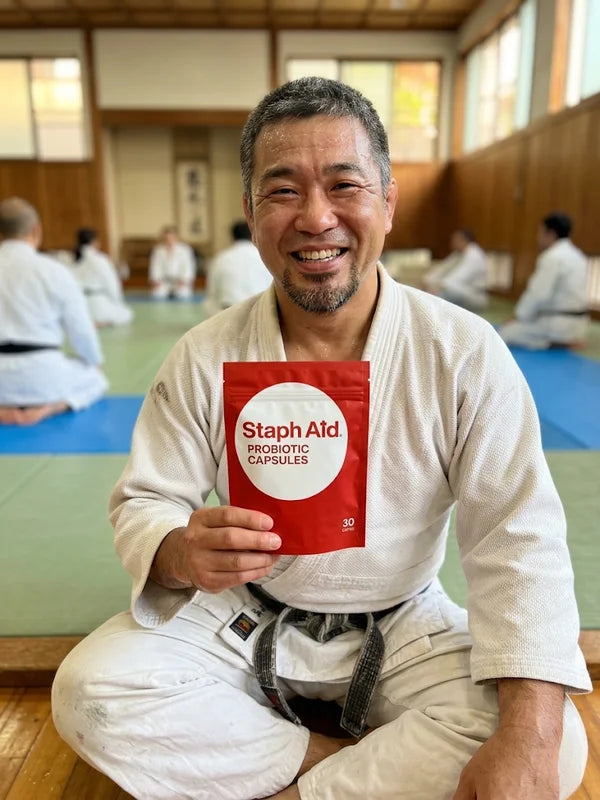
StaphAid is one capsule a day of our proprietary probiotic formula with Vitamin C, formulated to support skin, gut and immune health.* It is not a treatment for any infection.
Learn about StaphAidPracticing and playing with a scrape
Keep the scrape covered with a clean, dry bandage until it heals.2 For practice and games, the CDC says the covering should hold in any drainage and stay in place for the whole activity. If a wound can’t be covered that well, the athlete shouldn’t play.6
Stay out of whirlpools, therapy pools and swimming pools until it heals.2 Tell your athletic trainer about the injury, and put on a fresh bandage after you shower.
Wash your hands before and after you touch the wound or change the bandage.2 Put used bandages straight in the trash, not on a bench or in your bag.
Mats, fields and shared equipment
Facilities matter, too. The CDC advises keeping athletic facilities and shared equipment clean whether or not anyone has had an infection, cleaning shared equipment after each use, and focusing on surfaces that touch bare skin every day.6
In mat sports, the mat is the biggest shared surface of all. It’s fair for athletes and parents to ask how and how often it gets cleaned.
Lowering the odds
- Shower with soap right after practice or games.2
- Don’t share towels, razors or ointments from open containers.2
- Wash and completely dry your uniform and towels after each use.2
- Where your sport allows it, sleeves, tights or pads put a layer between your skin and the turf.
- Moisturize dry, cracked skin between games. Cracks are small breaks in your skin’s barrier, too.
- Think twice about shaving during the season. Shaving was one of the possible risk factors in the football outbreak above.1
For the full list, see what athletes shouldn’t share.
When to see a doctor
Most scrapes heal on their own. Call a doctor if you notice any of these:
- Redness or discoloration that is spreading around the scrape4
- More pain, warmth or swelling instead of less3,4
- Pus or other drainage3
- Red streaks moving away from the wound
- Fever or chills5
- A cut longer than three-quarters of an inch, deeper than a quarter inch, or one that won’t stop bleeding3
If you have a fever with fast-spreading redness or feel very ill, get urgent care or call 911. Don’t squeeze or drain a bump that forms in a scrape. A doctor can decide whether it needs testing or treatment. Learn more in MRSA symptoms.
- Centers for Disease Control and Prevention. Methicillin-Resistant Staphylococcus aureus Infections Among Competitive Sports Participants: Colorado, Indiana, Pennsylvania, and Los Angeles County, 2000–2003. MMWR, 2003;52(33). https://www.cdc.gov/mmwr/preview/mmwrhtml/mm5233a4.htm
- Centers for Disease Control and Prevention. Athletes: MRSA Prevention and Control. https://www.cdc.gov/mrsa/prevention/athletes.html
- American Academy of Dermatology. How to Treat Minor Cuts. https://www.aad.org/public/everyday-care/injured-skin/burns/treat-minor-cuts
- Mayo Clinic. Cuts and Scrapes: First Aid. https://www.mayoclinic.org/first-aid/first-aid-cuts/basics/art-20056711
- Centers for Disease Control and Prevention. MRSA Basics. https://www.cdc.gov/mrsa/about/index.html
- Centers for Disease Control and Prevention. Athletic Facilities: MRSA Prevention and Control. https://www.cdc.gov/mrsa/prevention/coaches-athletic-directors.html
This article is for general education and is not medical advice. If you think you have an infection, see a doctor. These statements have not been evaluated by the Food and Drug Administration. This product is not intended to diagnose, treat, cure, or prevent any disease.