

Can Staph Come Back? Why Some Infections Return
Repeat staph infections are common and frustrating. Here’s why they happen, from the staph you carry to the staph in your home, and how doctors help break the cycle.
- Yes. In one large study, about half of people with a staph skin infection had another within six months.1
- Common reasons include staph you already carry, staph shared within your home,2 and skin or health conditions.3
- Staph on household items was linked to a higher chance of another infection.1
- If infections keep returning, see a doctor. Some plans work best when the whole household takes part.2
Yes, and it’s more common than you might think
Staph infections can come back, and they often do. If you’ve had more than one, you’re in good company. In a study that followed 330 people with staph skin infections in Los Angeles and Chicago, 39% had another infection within three months, and 51% within six months.1 The people they lived with were affected too: about 13% reported a skin infection of their own within six months.1
If that’s you, you haven’t done anything wrong. Repeat infections usually have a reason, and finding it is the first step toward breaking the cycle. The good news is that most of those reasons are things you and your doctor can work on.
Reason 1: you may carry staph
Many people carry staph in their nose or on their skin without symptoms. Doctors call this colonization, and it usually comes before infection.2 Carrying staph isn’t your fault, and you can’t see or feel it. Once an infection clears, the staph you carry can still be there. A scratch, shaving nick or insect bite can give it a new way in. Researchers have also found that people with a history of repeat boils are more likely to carry staph in their nose.6
Read more about what it means to be a carrier.
Reason 2: staph is in your home
Staph passes back and forth between people who live together. Family members can carry it without symptoms and quietly share it again.2 That’s why a one-person fix often doesn’t hold. If you clear up but a partner or child still carries staph, it can find its way back to you. Towels, bedding, razors and bathroom surfaces are shared every day in most homes, which makes them easy stops along the way.
Household items matter, too. In the same study, people were more likely to have another infection when MRSA was found on items in their home. The researchers suggested that cleaning shared household items could help reduce repeat infections.1 MRSA can survive on surfaces for weeks, which gives it time to find its way back to skin.4

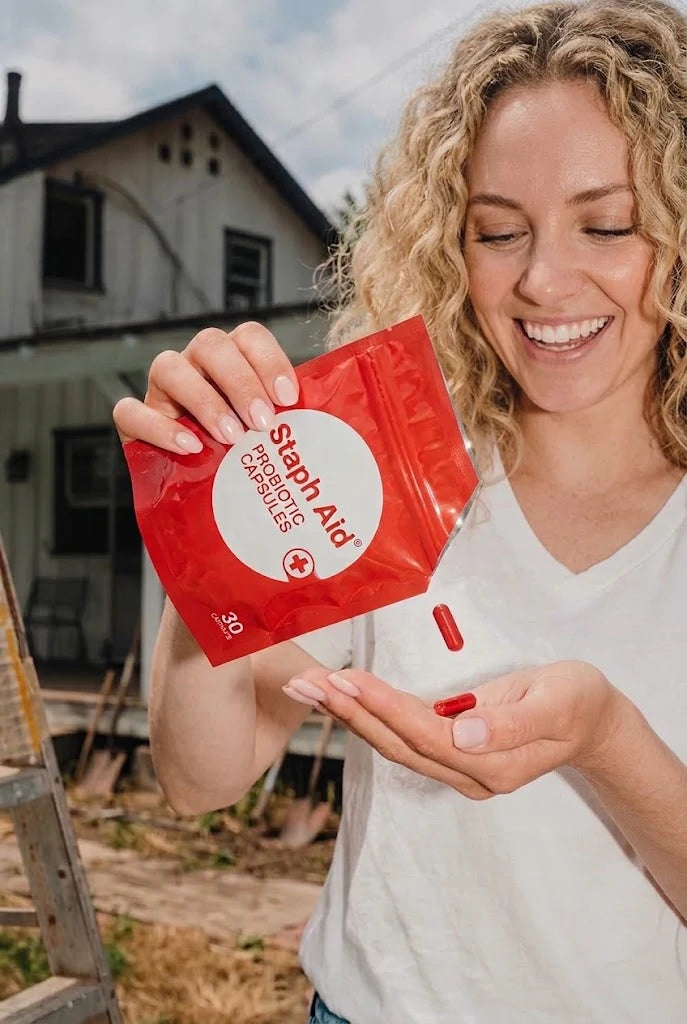
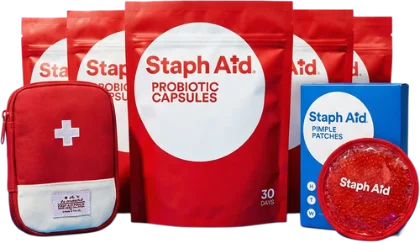
StaphAid is one capsule a day of our proprietary probiotic formula with Vitamin C, formulated to support skin, gut and immune health.* It is not a treatment for any infection.
Learn about StaphAidReason 3: skin and health factors
Some conditions make skin infections more likely, including acne, eczema, diabetes and a weakened immune system.3 Close contact with someone who has a staph infection raises the risk as well.3 Diabetes can make it harder for the body to fight infection.3 Eczema can leave small cracks in the skin, which give staph an easy way in. In the Los Angeles and Chicago study, a recent hospital stay was also linked to repeat infections.1
If boils keep showing up, ask your doctor to look for anything that might be making your skin easier for staph to get through. See why do I keep getting boils? for more.
Breaking the cycle
Start with a visit to your doctor. Experts say that for repeat infections, clearing staph from the body can make sense, and that a household-wide approach tends to work better than one person acting alone.2 Your doctor will decide whether that fits you and how to do it. They may also swab the sore or your nose to see exactly which germ is involved.4 Take any medicine exactly as prescribed, and go back if an infection isn’t getting better.
At home, these habits help, and they work best when everyone in the household follows them, not just the person with the infection:5
- Cover wounds with clean, dry bandages until they heal, and don’t pick at or pop sores.
- Clean your hands often, especially after touching a wound or changing a bandage.
- Don’t share towels, washcloths, razors or clothing.
- Wash laundry before others use it, and clean your hands after touching dirty clothes.
- Throw used bandages away in the regular trash.
- Clean shared household items and high-touch surfaces regularly.
When to see a doctor
Repeat infections are a good reason to check in, even if each one seems minor. Call a doctor if you have:
- Boils or skin infections that keep coming back3
- A boil that lasts more than two weeks, or one on your face3
- Fever or chills with a skin infection3
- Diabetes or a weakened immune system and any skin infection
Get urgent care or call 911 for a fever with fast-spreading redness, confusion, trouble breathing, or a baby who seems very sick.
Before your appointment, jot down when each infection started, where it was, and whether anyone else at home has had one. It helps your doctor spot the pattern. Bring a list of any medicines you took for past infections, too. And don’t squeeze or drain a boil yourself.
- Miller LG, Eells SJ, David MZ, et al. Staphylococcus aureus skin infection recurrences among household members: an examination of host, behavioral, and pathogen-level predictors. Clinical Infectious Diseases. 2015;60(5):753-763. https://doi.org/10.1093/cid/ciu943
- Creech CB, Al-Zubeidi DN, Fritz SA. Prevention of recurrent staphylococcal skin infections. Infectious Disease Clinics of North America. 2015;29(3):429-464. https://pmc.ncbi.nlm.nih.gov/articles/PMC4552962/
- Mayo Clinic. Boils and carbuncles: Symptoms and causes. https://www.mayoclinic.org/diseases-conditions/boils-and-carbuncles/symptoms-causes/syc-20353770
- Cleveland Clinic. MRSA (Methicillin-Resistant Staphylococcus Aureus). https://my.clevelandclinic.org/health/diseases/11633-methicillin-resistant-staphylococcus-aureus-mrsa
- Centers for Disease Control and Prevention. MRSA in the Community. https://www.cdc.gov/mrsa/community/index.html
- Sakr A, Brégeon F, Mège JL, Rolain JM, Blin O. Staphylococcus aureus nasal colonization: an update on mechanisms, epidemiology, risk factors, and subsequent infections. Frontiers in Microbiology. 2018;9:2419. https://doi.org/10.3389/fmicb.2018.02419
This article is for general education and is not medical advice. If you think you have an infection, see a doctor. These statements have not been evaluated by the Food and Drug Administration. This product is not intended to diagnose, treat, cure, or prevent any disease.