
Cleaning Your Home When Someone Has Staph
You don’t need to scrub the whole house. Focus on what skin and hands touch, clean before you disinfect, and give the product time to work.
- Staph spreads mostly through skin contact and things that touch skin, so target high-touch surfaces instead of fogging whole rooms.1
- Clean with soap or detergent first, then disinfect. Dirt can stop a disinfectant from working.2
- Use a product whose label says it works against MRSA, and leave it wet for the full contact time on the label.4
- Cleaning limits spread but doesn’t treat an infection. A doctor should check any sore that is red, warm, painful or draining.6
Focus on what touches skin
You don’t need to scrub your whole house from top to bottom. Staph, including MRSA, spreads mainly through contact with an infected wound or with things that have touched infected skin.6 So the goal is simple: clean the surfaces and objects that skin, hands and wounds touch most.
The CDC points to keyboards, phones and other handheld devices, plus anything that touches bare skin, such as chairs, benches, faucets, light switches and remote controls.1 Doorknobs and countertops belong on the list too.2
More isn’t always better. The CDC notes there is little evidence that spraying or fogging whole rooms prevents MRSA infections any better than a targeted approach.1
Clean first, then disinfect
Cleaning and disinfecting are two different jobs. Cleaning with soap or detergent and water removes dirt and many germs. Disinfecting uses a stronger product to kill the germs that are left.2
Do them in that order. Dirt and grime can keep a disinfectant from working, so wipe a surface clean before you disinfect it.2 The CDC suggests disinfecting when someone at home is sick or has a weakened immune system,2 which fits a household where someone has an active skin infection.
Pick a product that works against staph
Look for a disinfectant whose label says it works against MRSA or Staphylococcus aureus. The EPA keeps a list, called List H, of registered products that lab testing shows kill MRSA. You can check a product by matching the “EPA Reg. No.” printed on its label.4
Then follow the label exactly. The step people skip most is contact time: how long the surface has to stay wet for the product to work. It’s printed on the label, and it can be different for different germs.4 If you wipe the surface dry right away, the job may be only half done.
- Read the label before you start, and wear gloves if it says to.2
- Open a window or run a fan for fresh air.3
- Never mix bleach, or any disinfectant, with other cleaners. Some mixes give off fumes that are dangerous to breathe.3
- Check the maker’s instructions before cleaning phones, tablets and other electronics.1
- Store products away from children and pets, and wash your hands when you finish.2
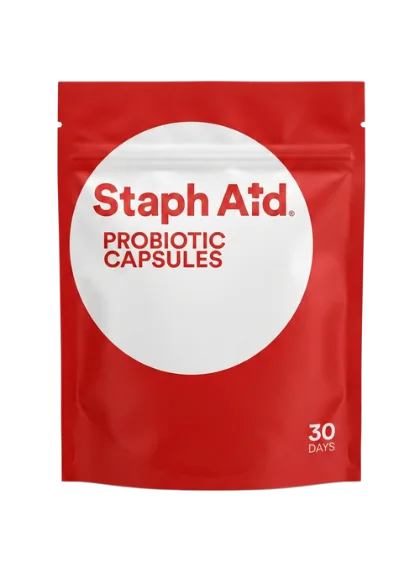
StaphAid is one capsule a day of our proprietary probiotic formula with Vitamin C, formulated to support skin, gut and immune health.* It is not a treatment for any infection.
Learn about StaphAidTowels, sheets and clothes
Laundry from a person who is sick can usually be washed with everyone else’s, using regular detergent and the right water temperature for the fabric.2 Drying matters as much as washing. For athletes, the CDC advises washing towels and clothes after each use and drying them completely in a dryer rather than on a line.5 That habit makes sense at home too, for the towels, washcloths and sheets the person with the infection uses.
Give each person their own towel and washcloth while the infection heals, and don’t share them.1 For more detail, see our guide to washing towels, sheets and clothes.
Bandages, bathrooms and shared items
The person with the infection should keep the wound covered with a clean, dry bandage until it heals, and follow the care plan from their doctor.1 Used bandages can go in the regular trash.1 Anyone who helps with a dressing change should wash their hands before and after. Our guide to caring for someone with MRSA at home covers this step by step.
Razors, towels and washcloths should never be shared.1 In a shared bathroom, wipe faucet handles, the toilet handle and light switches more often until the infection clears. A clean towel between bare skin and a shared seat or bench adds a simple barrier.1
When to see a doctor
Cleaning helps limit spread, but it doesn’t treat an infection. Call a doctor if anyone in your home has:
- A bump or sore that is red, swollen, warm, painful or full of pus6
- A skin infection with a fever6
- A skin infection that isn’t getting better within 48 hours6
- Redness that is spreading, or new sores showing up in other family members
- Any skin infection in a baby, an older adult, someone who is pregnant, or someone with diabetes or a weak immune system
Get urgent care or call 911 for a high fever with fast-spreading redness, confusion, trouble breathing, or a baby who seems very sick. Don’t squeeze or pop a sore;1 a doctor should decide how to treat it.
A simple routine while it heals
- Once a day, clean and then disinfect the handful of spots everyone touches.
- Keep the wound covered, and put used bandages straight in the trash.
- Wash towels and bedding often, and dry them fully in the dryer.
- Wash hands often, especially after dressing changes and laundry.
These steps are temporary. Once the infection has healed, your normal cleaning routine is usually enough.
- Centers for Disease Control and Prevention. Preventing Methicillin-resistant Staphylococcus aureus (MRSA). https://www.cdc.gov/mrsa/prevention/index.html
- Centers for Disease Control and Prevention. When and How to Clean and Disinfect Your Home. https://www.cdc.gov/hygiene/about/when-and-how-to-clean-and-disinfect-your-home.html
- Centers for Disease Control and Prevention. Cleaning and Disinfecting with Bleach. https://www.cdc.gov/hygiene/about/cleaning-and-disinfecting-with-bleach.html
- U.S. Environmental Protection Agency. EPA’s Registered Antimicrobial Products Effective Against Methicillin-resistant Staphylococcus aureus (MRSA) and/or Vancomycin-resistant Enterococcus faecalis/faecium (VRE) [List H]. https://www.epa.gov/pesticide-registration/epas-registered-antimicrobial-products-effective-against-methicillin
- Centers for Disease Control and Prevention. Athletes: MRSA Prevention and Control. https://www.cdc.gov/mrsa/prevention/athletes.html
- Centers for Disease Control and Prevention. Methicillin-resistant Staphylococcus aureus (MRSA) Basics. https://www.cdc.gov/mrsa/about/index.html
This article is for general education and is not medical advice. If you think you have an infection, see a doctor. These statements have not been evaluated by the Food and Drug Administration. This product is not intended to diagnose, treat, cure, or prevent any disease.