
Phones, Badges and Stethoscopes: Everyday Items That Carry Germs
You clean your hands dozens of times a shift. The phone, badge and stethoscope that go everywhere with you often get cleaned far less.
- In one hospital study, 94.5% of healthcare workers’ phones carried bacteria.1
- After a single exam, a stethoscope was more contaminated than most of the doctor’s hand, apart from the fingertips.2
- Lanyards are rarely washed, and a quarter of staph carriers in one study had their own strain on theirs.3
- Clean these items often, following the maker’s instructions, and clean your hands after touching them.45
Why everyday items matter
Hands get most of the attention in infection control, and they should. But the things in your hands and around your neck travel from room to room too, and many of them rarely get cleaned. The CDC lists keyboards and handheld electronic devices among the frequently touched items worth cleaning to prevent MRSA.4
These studies are small, and they measure bacteria, not infections. But the pattern is consistent: items that touch hands and skin all day pick up whatever is on them. Here’s what research has found on three items almost every healthcare worker carries.
Phones
Your phone goes everywhere: the nurses’ station, the break room, your car, your kitchen table. In a 2009 hospital study, researchers cultured the phones and hands of 200 healthcare workers. Bacteria turned up on 94.5% of the phones.1 Of the Staphylococcus aureus found on phones, 52% was methicillin resistant, meaning MRSA.1
Finding bacteria on a phone doesn’t mean it will cause an infection. It does mean your phone can undo the hand cleaning you just did. Your phone also comes home with you. The same phone you hold at work ends up on the kitchen counter and in your kids’ hands, so a wipe before you leave work is a habit worth building.
- Check the maker’s instructions before you clean a phone or tablet.4
- Use a cleanable case or cover, which makes wiping easier.4
- Wipe your phone at the start and end of each shift.
- Clean your hands after using your phone and before touching a patient.
Stethoscopes
A stethoscope touches patient after patient. In a study of 71 patients, doctors’ stethoscopes and hands were sampled right after a single physical exam. The diaphragm, the flat part that touches skin, was more contaminated than every part of the doctor’s hand except the fingertips.2 The same pattern held for MRSA in patients who carried it.2
The researchers concluded that a stethoscope’s contamination after one exam is comparable to parts of the doctor’s own hand, and they recommended disinfecting it after each patient.2 A quick wipe of the diaphragm and tubing, using a product your facility approves, takes only a few seconds.
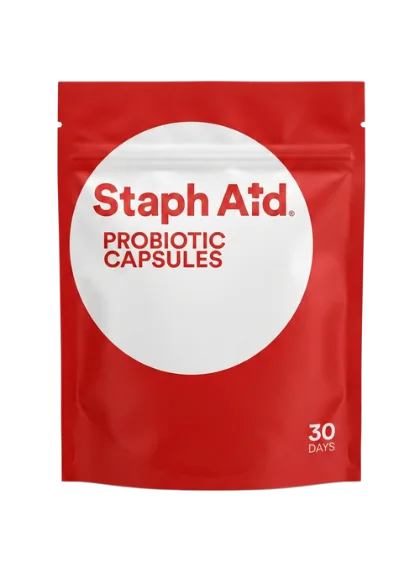
StaphAid is one capsule a day of our proprietary probiotic formula with Vitamin C, formulated to support skin, gut and immune health.* It is not a treatment for any infection.
Learn about StaphAidBadges and lanyards
ID badges often hang from a fabric lanyard worn all day, every day. A 2017 study tested 102 lanyards from hospital staff. About 9% carried S. aureus, and 26% of the staff who carried staph in their nose had the same strain on their lanyard.3
The lanyards were almost never washed. Only 9% had ever been laundered, and on average they had been in use for 22 months.3 The authors recommended against lanyards for staff in frontline clinical care, and suggested clipping the badge higher on the chest instead.3
If your workplace allows lanyards, choose one you can wash, and wash it regularly. A retractable badge clip is easier to wipe down, and you can clean it along with your phone at the end of a shift.
A simple routine
- Clean your hands after touching a patient or anything around them, and right after taking off gloves.5
- Wipe your stethoscope after every patient.2
- Wipe your phone, badge, pens and keys at least once a shift, with a product that’s safe for each.4
- Keep your phone off patient beds and tables.
- Wash lanyards with your scrubs, or switch to a clip.
Clothing is part of the picture too. Read Do scrubs carry germs home? for what the research says, and hand hygiene for caregivers for the basics that matter most.
Keep it in perspective
These studies measured germs on objects, not infections in patients or families. Contaminated items are one link in a chain, and clean hands break most of that chain.5 A few seconds of wiping, done every shift, is enough to keep these items from becoming the weak spot.
If your workplace has a policy on phones in patient areas, follow it. If not, a few rules of thumb work well: keep your phone put away during hands-on care, wipe it often, and clean your hands after you touch it.
When to see a doctor
If you or someone at home develops a skin problem, see a doctor for:
- A bump or sore that is red, swollen, warm, painful or full of pus6
- A skin infection with a fever, or one that isn’t better within 48 hours6
- Skin infections that keep coming back
Get urgent care or call 911 for fever with fast-spreading redness, confusion or trouble breathing. Don’t squeeze a sore; keep it covered.6
- Ulger F, et al. Are we aware how contaminated our mobile phones with nosocomial pathogens? Annals of Clinical Microbiology and Antimicrobials. 2009;8:7. https://doaj.org/article/3ddf112f043b4cf9be7c2b663dde1d5f
- Longtin Y, Schneider A, Tschopp C, et al. Contamination of stethoscopes and physicians’ hands after a physical examination. Mayo Clinic Proceedings. 2014;89(3):291–299. https://doi.org/10.1016/j.mayocp.2013.11.016
- Murphy CM, et al. Identification badge lanyards as infection control risk: a cross-sectional observation study with epidemiological analysis. Journal of Hospital Infection. 2017;96(1):63–66. https://www.sciencedirect.com/science/article/pii/S0195670117300142
- Centers for Disease Control and Prevention. Preventing Methicillin-resistant Staphylococcus aureus (MRSA). https://www.cdc.gov/mrsa/prevention/index.html
- Centers for Disease Control and Prevention. Clinical Safety: Hand Hygiene for Healthcare Workers. https://www.cdc.gov/clean-hands/hcp/clinical-safety/index.html
- Centers for Disease Control and Prevention. Methicillin-resistant Staphylococcus aureus (MRSA) Basics. https://www.cdc.gov/mrsa/about/index.html
This article is for general education and is not medical advice. If you think you have an infection, see a doctor. These statements have not been evaluated by the Food and Drug Administration. This product is not intended to diagnose, treat, cure, or prevent any disease.