
Wound Care at Home: Keeping Cuts and Scrapes Clean
Most cuts and scrapes heal well with simple care. Here’s how to clean and cover them, what to skip, and the signs that a wound needs a doctor.

- Rinse cuts under clean running water and wash around them with soap. Skip hydrogen peroxide and iodine.1
- Keep wounds moist with petroleum jelly and covered with a bandage that you change every day.1,2
- Ask about a tetanus shot for a deep or dirty wound if your last one was more than 5 years ago.1
- See a doctor for deep wounds, bites, bleeding that won’t stop, or signs of infection.3
Why good wound care matters
Your skin keeps germs out, and a cut or scrape opens a gap in it. To help prevent staph and MRSA infections, the CDC advises keeping cuts and scrapes clean and covered with a bandage until they heal.5
The good news is that most everyday cuts need only a few minutes of care and a daily check. Here’s how to do it, step by step. Athletes can follow the same steps, and our guide to turf burns and staph covers scrapes from the field.
Step 1: Stop the bleeding and clean it
Start by washing your own hands.1 Then:
- Stop the bleeding. Press gently with a clean cloth or bandage, and raise the area if you can, until it stops.1
- Rinse it. Hold the wound under clean running water. Wash around it with soap, but try not to get soap in the wound itself.1
- Remove debris. Use tweezers cleaned with rubbing alcohol to lift out small bits of dirt. If you can’t get it all out, see a doctor.1
For a small puncture, such as from a thorn, rinse it under running water for about 5 minutes and then wash it with soap. Look for anything stuck inside, and get it checked if you find something or if part of the object seems to be missing.3
Step 2: Keep it moist and covered
A scab may look like progress, but it actually slows healing and makes a scar more likely. Dermatologists recommend a thin layer of petroleum jelly to keep the wound moist and help prevent a scab from forming.2 If any ointment gives you a rash, stop using it.1
Then cover the wound with an adhesive bandage, gauze or a non-stick pad to keep it clean.1,2 Very small scratches can be left uncovered.1 For a larger scrape, hydrogel or silicone gel dressings may help, so ask a pharmacist which one fits.2
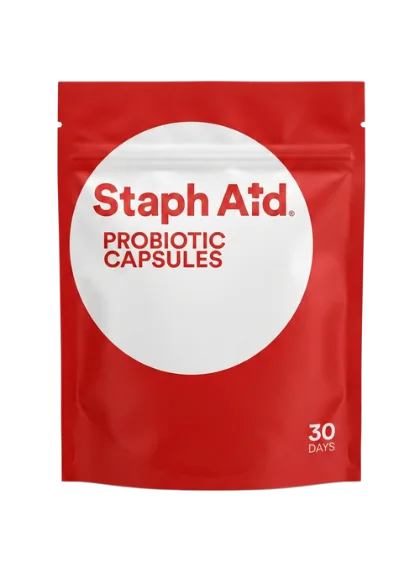
StaphAid is one capsule a day of our proprietary probiotic formula with Vitamin C, formulated to support skin, gut and immune health.* It is not a treatment for any infection.
Learn about StaphAidStep 3: Check and change it daily
- Change the bandage at least once a day, and any time it gets wet or dirty.1
- Wash your hands before and after each change.
- Look at the wound each time for redness that is spreading, swelling or drainage.1
- Throw used bandages away in the regular trash.5
- Keep the wound covered until it has fully healed.5
If adhesive bothers your skin, use non-stick gauze held in place with paper tape.1,2 Once the wound has healed, a broad-spectrum sunscreen with SPF 30 or higher can help a scar fade.2
It helps to keep a small kit ready at home: adhesive bandages, non-stick gauze, paper tape, petroleum jelly and a pair of tweezers. When everything is in one place, a cut gets cleaned and covered right away instead of later.
What to skip
Hydrogen peroxide and iodine. They can irritate the wound. Clean running water does the job.1
Picking. Don’t pick at scabs or pop sores.5
Sharing. Don’t share towels, washcloths or razors, especially while a wound is healing.5
Home remedies for infection. If a wound starts to look infected, don’t try to treat it yourself or squeeze anything out of it. A doctor should decide what it needs.
Don’t forget tetanus
Tetanus bacteria can get into the body through broken skin, usually through an injury.4 The CDC recommends that adults stay up to date with a tetanus booster every 10 years.4
If a wound is deep or dirty and your last tetanus shot was more than 5 years ago, you may need one now.1 Puncture wounds, like stepping on a nail, and wounds with dirt, soil, feces or saliva in them are the ones to ask a doctor about.4 If you don’t know when you had your last tetanus shot, say so. For a serious or dirty wound, a doctor may give extra protection along with the vaccine.4
When to see a doctor
Call 911 if bleeding is severe or doesn’t stop after 10 minutes of pressure, if the person can’t feel or move the injured area normally, or if they are badly hurt in other ways.3 See a doctor soon if:
- The wound is deep (more than about a quarter inch), large, on the face, or reaches the bone3
- It came from a human or animal bite, a fishhook or a rusty object3
- Something is stuck in it that you can’t remove1,3
- It shows signs of infection: spreading redness, more pain, warmth, swelling, drainage, red streaks or fever1,3
- Your tetanus shot isn’t up to date3
If you have diabetes or a weakened immune system, or the wound is on a baby, check with a doctor sooner rather than later. And if a spot near a healing cut turns into a red, swollen bump, our guide to what staph looks like can help you describe it to your doctor.
- Mayo Clinic. Cuts and scrapes: First aid. https://www.mayoclinic.org/first-aid/first-aid-cuts/basics/art-20056711
- American Academy of Dermatology. Proper wound care: How to minimize a scar. https://www.aad.org/public/everyday-care/injured-skin/burns/wound-care-minimize-scars
- MedlinePlus (U.S. National Library of Medicine). Cuts and puncture wounds. https://medlineplus.gov/ency/article/000043.htm
- Centers for Disease Control and Prevention. About Tetanus. https://www.cdc.gov/tetanus/about/index.html
- Centers for Disease Control and Prevention. Preventing Methicillin-resistant Staphylococcus aureus (MRSA). https://www.cdc.gov/mrsa/prevention/index.html
This article is for general education and is not medical advice. If you think you have an infection, see a doctor. These statements have not been evaluated by the Food and Drug Administration. This product is not intended to diagnose, treat, cure, or prevent any disease.