
Bacillus subtilis Probiotics: What They Are and What the Research Says
A spore-forming bacterium found in soil and fermented foods, this probiotic works differently from yogurt-style probiotics. Here’s what it is and what studies have found.

- Bacillus subtilis is a bacterium found in soil and in fermented foods such as natto.1
- It can form tough spores, which helps it hold up during processing and storage.1
- Effects depend on the exact strain and amount, so research on one strain doesn’t apply to all of them.2
- Probiotics aren’t right for everyone. Ask your doctor first, especially if you are seriously ill or have a weak immune system.2
What it is
Bacillus subtilis is a bacterium that lives in soil and shows up in fermented foods such as natto, a traditional fermented soybean dish.1 Some Bacillus strains are used as probiotics around the world.1
It belongs to a large group of bacteria called Bacillus. That group also includes harmful relatives, such as B. anthracis, and species like B. cereus that have some toxin-making strains. That’s one reason experts say the safety of each Bacillus strain has to be checked case by case.1
Why spores matter
What makes Bacillus different is its ability to form spores. A spore is a tough, dormant form of the bacterium, a bit like a seed. It can wait out harsh conditions and become active again later.
Researchers note that because of this, Bacillus bacteria are more stable during food processing and storage than many other probiotic bacteria, and their spores are well equipped to handle the harsh conditions of the digestive tract.1
Being hardy doesn’t automatically make a strain helpful, though. Whether a given strain does anything useful in people is a separate question that only studies of that strain can answer.
How it differs from other probiotics
Probiotics are live microorganisms that can provide a health benefit when taken in large enough amounts.2 Most familiar ones are lactic acid bacteria, the kind found in yogurt, such as Lacticaseibacillus rhamnosus GG, or yeasts such as Saccharomyces boulardii.2
The key point for any probiotic: its benefits, if any, depend on the specific strain and the number of live organisms, measured in CFUs (colony-forming units).2 Two probiotics with the same species name on the label can behave very differently. That’s why research papers name the exact strain, such as the MB40 in the staph trial described below.4
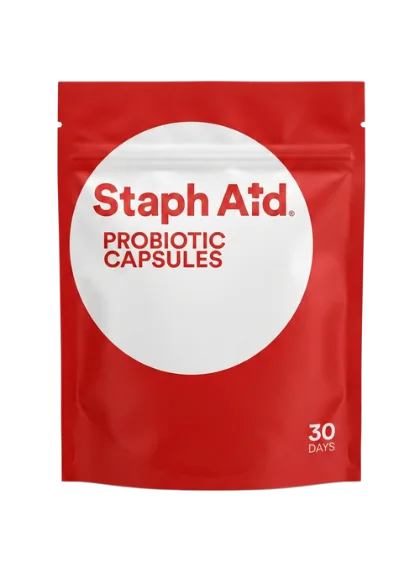
StaphAid is one capsule a day of our proprietary probiotic formula with Vitamin C, formulated to support skin, gut and immune health.* It is not a treatment for any infection. StaphAid uses its own B. subtilis strain and was not part of the studies described here.
Learn about StaphAidWhat the research says about staph
Doctors see lowering staph carriage as a possible way to reduce staph infections, but current approaches have drawbacks.4 Most of the interest in B. subtilis as another option comes from NIH-led research in Thailand. In a 2018 study of 200 people, no S. aureus was found in anyone whose gut samples contained Bacillus. In mice, B. subtilis cleared staph from the gut, using substances called fengycins that block staph’s quorum-sensing signals.3,6
A 2023 phase 2 trial followed up in people. It enrolled 115 adult staph carriers in Thailand. Those who took 250 mg of B. subtilis strain MB40 once a day for 30 days had 96.8% less staph in the gut and 65.4% less in the nose than those who took a placebo.4
Three caveats matter. The results apply to that strain and dose, not to probiotics in general. The trial measured carriage, not infections. And the researchers say larger studies are needed.4,5 Our article on the NIH research goes into more detail.
Reading a probiotic label
Because effects depend on the strain, the most useful thing on a label is the full name.2 Look for:
- The genus, species and strain code, such as Bacillus subtilis MB40, not just “Bacillus subtilis.”
- The amount, given in CFUs or milligrams.2 If a label doesn’t list the strain, you can’t match it to any study.
- Whether that exact strain, at that amount, has been studied for the use you care about.
Be wary of big promises. Research on one strain can’t simply be borrowed to support a different one, and no probiotic has been shown to treat or prevent staph infections.
Safety and when to ask a doctor
Probiotics aren’t right for everyone. They can cause infections or serious illness in premature babies, and problems such as bacterial infections in people who are already very ill or have weak immune systems.2
Talk with your doctor before trying any probiotic if you are pregnant, have a serious illness, have a weakened immune system, or are thinking about one for a baby or an older relative. Your doctor can also help you decide which one, how much and for how long.2 Mention any probiotic you take at checkups, the same way you would a medicine.
When to see a doctor
No probiotic is a treatment for an infection. See a doctor if you notice:
- A bump or sore that is red, swollen, warm, painful or full of pus
- Redness that is spreading, or red streaks moving away from a wound
- Fever or chills with a skin infection
- Feeling unwell after starting a probiotic, especially if you have a serious illness or a weak immune system2
If you have a fever with fast-spreading redness, confusion or trouble breathing, get urgent care or call 911.
- Elshaghabee FMF, Rokana N, Gulhane RD, Sharma C, Panwar H. Bacillus as potential probiotics: status, concerns, and future perspectives. Frontiers in Microbiology, 2017;8:1490. https://www.frontiersin.org/journals/microbiology/articles/10.3389/fmicb.2017.01490/full
- NIH Office of Dietary Supplements. Probiotics: Fact Sheet for Consumers. https://ods.od.nih.gov/factsheets/Probiotics-Consumer/
- National Institutes of Health. NIH study finds probiotic Bacillus eliminates Staphylococcus bacteria. News release, October 10, 2018. https://www.nih.gov/news-events/news-releases/nih-study-finds-probiotic-bacillus-eliminates-staphylococcus-bacteria
- Piewngam P, et al. Probiotic for pathogen-specific Staphylococcus aureus decolonisation in Thailand: a phase 2, double-blind, randomised, placebo-controlled trial. The Lancet Microbe, 2023. https://www.thelancet.com/journals/lanmic/article/PIIS2666-5247(22)00322-6/fulltext
- National Institutes of Health. Probiotic markedly reduces S. aureus colonization in Phase 2 trial. News release, January 17, 2023. https://www.nih.gov/news-events/news-releases/probiotic-markedly-reduces-s-aureus-colonization-phase-2-trial
- Piewngam P, et al. Pathogen elimination by probiotic Bacillus via signalling interference. Nature, 2018;562:532–537. https://www.nature.com/articles/s41586-018-0616-y
This article is for general education and is not medical advice. If you think you have an infection, see a doctor. These statements have not been evaluated by the Food and Drug Administration. This product is not intended to diagnose, treat, cure, or prevent any disease.