
Your Skin Microbiome: The Good Bacteria That Live on You
Millions of bacteria, fungi and viruses live on your skin, and most of them are on your side. Here’s what they do, where staph fits in, and how to look after your skin.
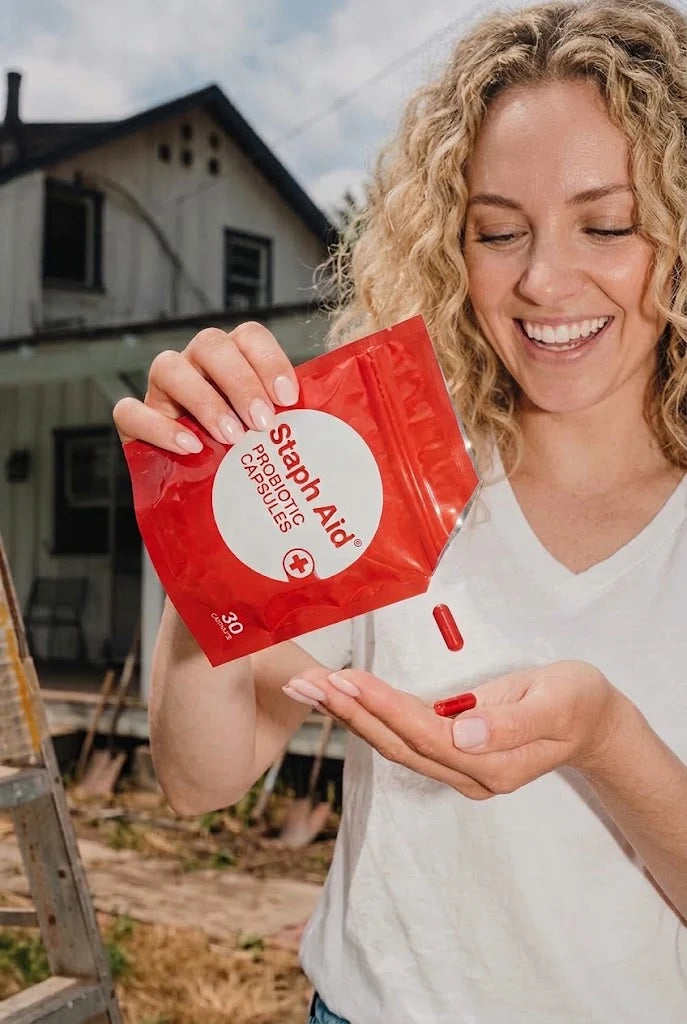
- Your skin is home to millions of bacteria, fungi and viruses, known as the skin microbiome.1
- Friendly skin bacteria help train your immune system and can compete with staph.1
- Some skin conditions, including eczema, are linked with a shift in these communities.1,3
- There’s no proven routine to “balance” your microbiome, but gentle, moisturizing skin care helps your skin barrier.5
What the skin microbiome is
Your skin is home to millions of bacteria, fungi and viruses. Together they’re called the skin microbiome.1 Most of them are harmless, and many are helpful.
Skin is a tough place to live. It’s dry, low in nutrients and slightly acidic, so the microbes that thrive there are well adapted to it.1
In a healthy adult, these communities tend to stay stable over time, even as your surroundings change. Each person’s mix is also a little different, shaped by the body site and by the individual.1
Different neighborhoods on one body
Your skin isn’t one habitat. It’s more like a map of neighborhoods. Oily areas, moist areas such as skin folds, and dry areas each host different mixes of microbes.1
Oily areas, for example, favor bacteria that feed on skin oils, such as Cutibacterium acnes (also known as Propionibacterium acnes).1 Moist and dry areas have their own regulars, suited to those conditions.1
So when researchers talk about “the” skin microbiome, they really mean many small communities, each matched to its patch of skin.
What the good bacteria do
Scientists are still learning, but research points to a few ways skin microbes help:
- They train your immune system. Skin microbes help teach the skin’s immune defenses how to respond.1
- They compete with harmful bacteria. Common skin bacteria such as Staphylococcus epidermidis can get in the way of S. aureus settling in.1
- They make protective substances. Some friendly skin bacteria produce natural antimicrobials that act against S. aureus.1
- They support the skin barrier. A study highlighted by the NIH found that S. epidermidis makes an enzyme that helps produce ceramides, fats that keep skin from losing water. The enzyme turned up in 98% of samples tested. In mice exposed to irritants or dry conditions, the bacteria helped the skin hold on to water. It’s a two-way deal: the bacteria get food, and the skin gets protection.2
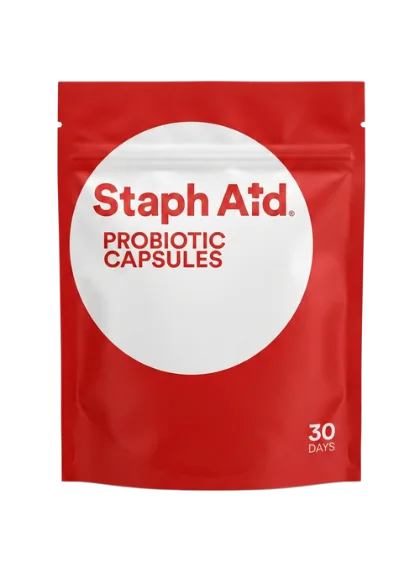
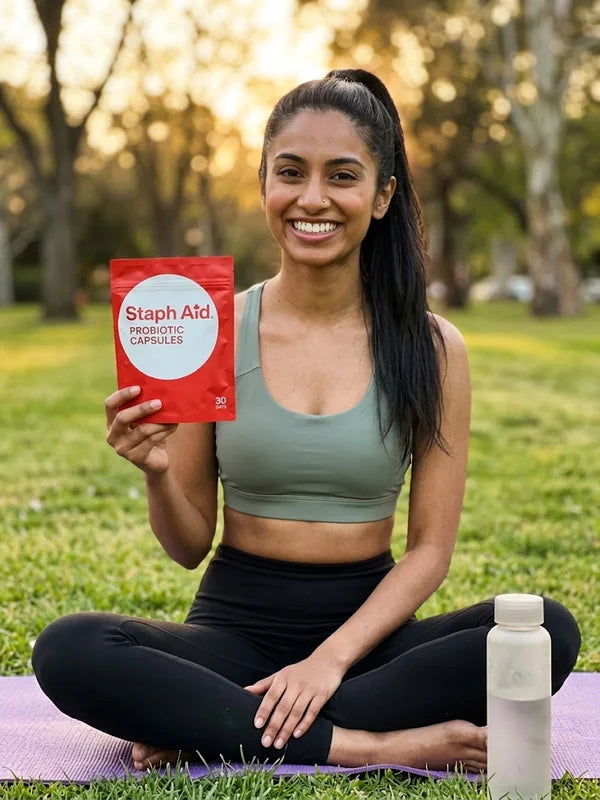
StaphAid is one capsule a day of our proprietary probiotic formula with Vitamin C, formulated to support skin, gut and immune health.* It is not a treatment for any infection.
Learn about StaphAidWhere staph fits in
Staphylococcus aureus is part of many people’s normal microbes. About 30% of people carry it in their noses, usually without harm.4 It becomes a problem when it gets past the skin, through a cut, scrape or other break.
Some skin diseases are linked with an altered mix of skin microbes.1 In eczema (atopic dermatitis), for example, UC San Diego researchers found that people lacked the friendly skin bacteria that make antimicrobial peptides against staph, while healthy skin had plenty of them.3 In a small early test, applying those bacteria to eczema patches lowered staph levels.3 This is early research, not a treatment you can use at home.
It also doesn’t mean staph relatives are all bad. Some of the most helpful bacteria on your skin, such as S. epidermidis and S. hominis, are close cousins of S. aureus.3 What matters is which kinds are there, and in what balance.1 See staph and eczema for more.
Everyday care for your skin barrier
There’s no proven routine for “balancing” your skin microbiome. What dermatologists do recommend is basic care that keeps skin from drying out and cracking. Think of it as looking after the home your good bacteria live in:
- Keep showers and baths to 5 to 10 minutes, with warm rather than hot water.5
- Wash with a gentle cleanser, and use only enough to remove dirt.5
- Pat your skin gently dry, then moisturize right away, while it’s still damp.5
- Choose fragrance-free cleansers and moisturizers, and creams or ointments rather than lotions for very dry skin.5
- Use a humidifier when indoor air is dry, and wear loose cotton if tight or rough fabrics irritate your skin.5
- Don’t share towels or razors.4
- Keep cuts and scrapes clean and covered until they heal, and try not to scratch or pick at broken skin.
If your skin stays dry, itchy or irritated even with good habits, a dermatologist can help find out why.
When to see a doctor
See a doctor or dermatologist if you notice:
- A bump or patch that is red, swollen, warm, painful or full of pus
- Redness that is spreading, or red streaks moving away from a wound
- Fever or chills with a skin problem
- Eczema that is oozing, crusting or suddenly getting worse
- Skin infections that keep coming back
If you have a fever with fast-spreading redness or feel very ill, get urgent care or call 911. Don’t try to treat a suspected skin infection with home remedies. A doctor can test it and choose the right treatment. For the basics, read our guide to staph infections.
- Byrd AL, Belkaid Y, Segre JA. The human skin microbiome. Nature Reviews Microbiology, 2018;16(3):143–155. https://www.nature.com/articles/nrmicro.2017.157
- National Institutes of Health. Compound produced by bacteria protects the skin. NIH Research Matters, March 1, 2022. https://www.nih.gov/news-events/nih-research-matters/compound-produced-bacteria-protects-skin
- UC San Diego Health. Transplanting good bacteria to kill staph. February 22, 2017. https://today.ucsd.edu/story/transplanting_good_bacteria_to_kill_staph
- Centers for Disease Control and Prevention. Staphylococcus aureus Basics. https://www.cdc.gov/staphylococcus-aureus/about/index.html
- American Academy of Dermatology. Dermatologists’ top tips for relieving dry skin. https://www.aad.org/public/everyday-care/skin-care-basics/dry/dermatologists-tips-relieve-dry-skin
This article is for general education and is not medical advice. If you think you have an infection, see a doctor. These statements have not been evaluated by the Food and Drug Administration. This product is not intended to diagnose, treat, cure, or prevent any disease.