
Can Probiotics Help With Staph? What the NIH Research Found
An NIH-led team found that one specific probiotic strain lowered how much staph people carried. Here’s what the studies showed, and what they didn’t.
- In a 2018 study of 200 people in rural Thailand, no staph was found in anyone whose gut samples contained Bacillus bacteria.2,3
- In a 2023 trial, one B. subtilis strain lowered staph in the gut by 96.8% and in the nose by 65.4% compared with placebo.4
- The trial measured how much staph people carried, not whether they got infections.4
- The results apply to that strain and dose only, not to probiotics in general. Larger studies are needed.5
The short answer
Not in any proven way yet. In a small NIH-led trial, one specific probiotic strain, Bacillus subtilis MB40, lowered the amount of staph that people carried in their gut and nose.4 That is an interesting result. But it measured carriage, not infections, and it tells you about that one strain at that one dose.
Here’s what the research actually found, and why the details matter.
Why researchers care about carrying staph
About 30% of people carry staph in their noses, usually without any harm.1 Carrying staph without symptoms is called colonization, and it isn’t the same as having an infection. Staph can also live in the gut.3
Doctors see reducing carriage, called decolonization, as a useful way to lower staph infection rates. But approaches applied to the nose or skin have had limited success, and using antibiotics by mouth for this is not advised, because they disrupt the body’s other bacteria and can drive antibiotic resistance.4 So researchers have been looking for other ways to lower carriage.
The 2018 discovery in Thailand
In a study published in Nature in 2018, an NIH-led team tested gut and nose samples from 200 people in rural Thailand.2,3 About half had Bacillus bacteria in their gut samples, mostly B. subtilis.3 No S. aureus was found in anyone whose gut samples contained Bacillus.3
To learn why, the team moved to mice. When mice with staph in their guts were fed B. subtilis spores, the staph was cleared from their guts. A version of the bacteria that couldn’t make substances called fengycins had no effect.3 That was an important clue about how Bacillus might work.
Fengycins are lipopeptides that block staph’s quorum sensing, the chemical signaling bacteria use to sense their numbers and change their behavior. Staph needs that signaling to settle in the gut.2,3 The human part of this study was a snapshot: it showed a link, not proof that Bacillus caused the difference.
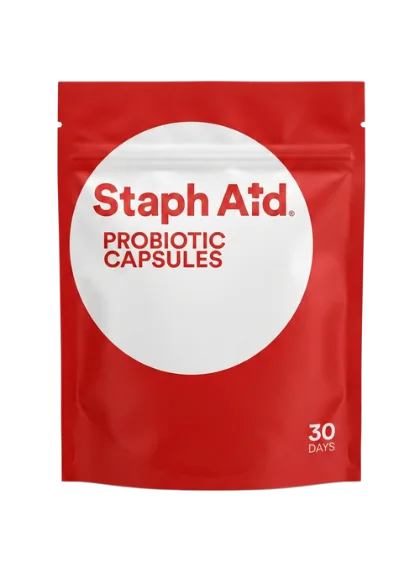
StaphAid is one capsule a day of our proprietary probiotic formula with Vitamin C, formulated to support skin, gut and immune health.* It is not a treatment for any infection. StaphAid uses its own B. subtilis strain and was not part of the studies described here.
Learn about StaphAidThe 2023 human trial
The next step was a phase 2 trial, published in The Lancet Microbe in 2023. It enrolled 115 adults in Thailand who carried staph. Neither participants nor researchers knew who got what.4 A phase 2 trial is a mid-stage study. It checks whether something seems to work, and is safe enough, before testing in larger groups.
- What they took: 55 people took 250 mg of B. subtilis strain MB40 once a day for 30 days. 60 people took a placebo.4
- What happened: compared with placebo, staph fell by 96.8% in the gut and by 65.4% in the nose. The placebo group showed no change.4,5
- Side effects: no severe side effects were reported, and moderate ones were rare and no more common than with placebo.4
NIH researchers explained that the probiotic doesn’t destroy staph. It strongly reduces staph’s ability to settle in and stay.5
What the research doesn’t show
- It measured carriage, not infections. The trial counted how much staph people carried. It did not test whether anyone got fewer infections.4
- It applies to one strain and dose. The results are for MB40 at 250 mg a day. The health effects of a probiotic depend on its specific strains and amounts, so they don’t carry over to probiotics in general.6
- It was one fairly small trial. The researchers have said larger, longer trials are needed.5
- It studied a specific group. Participants were adults without recent antibiotics or hospital stays.4
Put simply, this research is a promising lead, not a finished answer. Lowering carriage is a sensible goal to study, but only trials that count actual infections can show whether it protects people.
What this means for you
For now, everyday habits are still the proven basics: wash your hands, keep cuts covered, and don’t share towels or razors.1 Our guide to lowering your risk of staph covers the rest. If you’ve had repeat staph infections, raise it with your doctor, who can look at what might be behind them.
If you’re thinking about any probiotic, talk with your doctor first, especially if you are seriously ill, have a weakened immune system, or are asking about a premature baby. Probiotics can cause problems in those groups.6 Read more in Bacillus subtilis probiotics.
When to see a doctor
No probiotic is a treatment for a staph infection. Get medical care if you notice:
- A bump or sore that is red, swollen, warm, painful or full of pus
- Redness that is spreading, or red streaks moving away from a wound
- Fever or chills with a skin infection
- A skin infection that keeps coming back
If you have a fever with fast-spreading redness, confusion or trouble breathing, get urgent care or call 911.
- Centers for Disease Control and Prevention. Staphylococcus aureus Basics. https://www.cdc.gov/staphylococcus-aureus/about/index.html
- Piewngam P, et al. Pathogen elimination by probiotic Bacillus via signalling interference. Nature, 2018;562:532–537. https://www.nature.com/articles/s41586-018-0616-y
- National Institutes of Health. NIH study finds probiotic Bacillus eliminates Staphylococcus bacteria. News release, October 10, 2018. https://www.nih.gov/news-events/news-releases/nih-study-finds-probiotic-bacillus-eliminates-staphylococcus-bacteria
- Piewngam P, et al. Probiotic for pathogen-specific Staphylococcus aureus decolonisation in Thailand: a phase 2, double-blind, randomised, placebo-controlled trial. The Lancet Microbe, 2023. https://www.thelancet.com/journals/lanmic/article/PIIS2666-5247(22)00322-6/fulltext
- National Institutes of Health. Probiotic markedly reduces S. aureus colonization in Phase 2 trial. News release, January 17, 2023. https://www.nih.gov/news-events/news-releases/probiotic-markedly-reduces-s-aureus-colonization-phase-2-trial
- NIH Office of Dietary Supplements. Probiotics: Fact Sheet for Consumers. https://ods.od.nih.gov/factsheets/Probiotics-Consumer/
This article is for general education and is not medical advice. If you think you have an infection, see a doctor. These statements have not been evaluated by the Food and Drug Administration. This product is not intended to diagnose, treat, cure, or prevent any disease.