
Staph and Eczema: Why Eczema-Prone Skin Is More Vulnerable
Eczema-prone skin cracks, itches and carries more staph than healthy skin. Here’s why that matters, the signs of infection, and the daily habits that help.

- Eczema weakens the skin barrier, and scratching opens small breaks where staph can get in.1
- Staph is found on about 70% of eczema patches, far more often than on the skin of people without eczema.4
- Honey-colored crusts, pus-filled blisters and spreading redness can mean eczema is infected.5
- Fever with a rash, or clusters of painful crusted bumps, needs medical care right away.5
Why eczema skin is an easy target
Healthy skin works like a wall. It holds water in and keeps germs out. With eczema, also called atopic dermatitis, that wall is weaker. The outer layer of skin is damaged, so it dries out and cracks more easily.1
Then comes the itch. Scratching opens tiny breaks in the skin, and those breaks are a way in for bacteria, viruses and fungi.1 Staph, the bacterium Staphylococcus aureus, needs exactly that kind of opening to cause an infection. Pediatricians list eczema right alongside cuts, scrapes and piercings as openings that let staph in.2
Staph is more common on eczema skin
Staph is everywhere. About 30% of people carry it in their nose, and most never have a problem with it.3 People with eczema carry it much more often.
A large review pulled together 95 studies with more than 5,000 people. It found staph on about 70% of eczema patches, on 39% of nearby skin without a rash, and in the nose of 62% of people with eczema.4 At every one of those sites, people with eczema were far more likely to carry staph than people without it.4
Carrying staph is not the same as having an infection. It does mean that when eczema skin breaks open, staph is often already close by. That is why it pays to know what an infected patch looks like.
Signs eczema may be infected
Infected eczema can be hard to tell apart from a regular flare. Dermatologists say these signs point to a staph infection:5
- Yellow-orange or honey-colored crusts, often on top of a patch of eczema
- Blisters filled with pus
- Red, swollen bumps
- Redness or red streaks that are spreading
Infected skin may also ooze, burn, swell or itch more than usual. Some people feel sick, with a fever or chills.1
Staph isn’t the only germ to watch for. The virus that causes cold sores can also spread across eczema skin. This is called eczema herpeticum. It shows up as small, crusted bumps that are often painful and can come with a fever, and it needs medical care right away.5
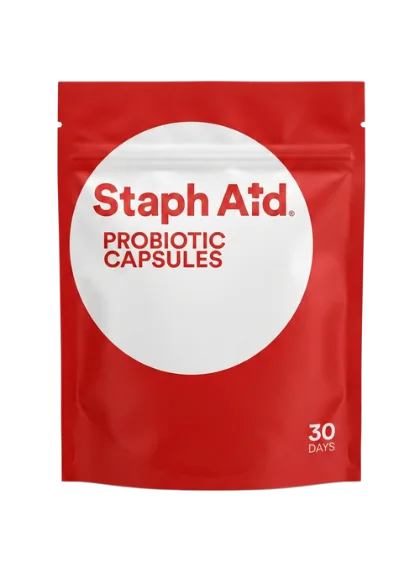
StaphAid is one capsule a day of our proprietary probiotic formula with Vitamin C, formulated to support skin, gut and immune health.* It is not a treatment for any infection.
Learn about StaphAidIf your child has eczema
Young children can’t always tell you when a flare feels different, and they may keep scratching no matter how often you ask them to stop. That puts the job of spotting changes on you.
Bath time is a good moment to look. Check for new crusts, pus bumps or redness that is spreading. Pediatricians say it’s especially important to call the doctor when skin changes come with a fever.2 If you see honey-colored crusts, our guide to impetigo explains one common cause in kids.
If your child does get a skin infection, they can usually keep going to school or daycare as long as the area can be bandaged and the drainage stays contained.2 Keep them out of swimming pools, whirlpools and contact sports until it heals.2
When to see a doctor
Call your doctor or dermatologist if you notice signs of infection, even without a fever.5 Get medical care right away for any of these:
- A fever of 100.4°F or higher, chills or flu-like symptoms along with a rash5
- Redness or red streaks that are spreading
- Clusters of small, painful, crusted bumps, especially with a fever5
- Severe pain or swelling1
- A baby or young child with eczema who seems very sick, is hard to wake or won’t feed
If someone has a fever with fast-spreading redness, seems confused or has trouble breathing, go to urgent care or call 911. Don’t try to treat an infected patch with home remedies, and don’t squeeze any bumps. A doctor can check it, test it if needed and choose the right treatment.
Before the visit, it helps to take a photo of the area each day so the doctor can see how it has changed. Bring a list of every cream, ointment and moisturizer you use, too.
Everyday habits that protect eczema skin
You can’t control every germ, but you can help the skin barrier do its job. These habits come from dermatologists and other skin health experts:
- Moisturize often. Well-moisturized skin cracks less, which leaves fewer openings for germs.5
- Keep your moisturizer clean. Use a pump bottle, or scoop cream out with a clean spoon instead of dipping your fingers into the jar.5
- Bathe the way your dermatologist suggests. Regular bathing helps wash germs off the skin.5
- Try not to scratch. Every scratch can open a new break in the skin.1
- Wash your hands often.1
- Don’t share towels or razors.3
- Keep infected spots clean and covered until a doctor has seen them.1
If your skin does get infected, ask your dermatologist whether to pause wet wraps or other covered treatments until it clears. Dermatologists often stop these while an infection is present.5 A steady skin care routine, plus a quick call when something looks different, are your two best tools.
- Cleveland Clinic. Infected Eczema: What It Looks Like, Treatment and Prevention. https://my.clevelandclinic.org/health/diseases/infected-eczema
- American Academy of Pediatrics (HealthyChildren.org). MRSA and Children: Parent FAQs. https://www.healthychildren.org/English/health-issues/conditions/infections/Pages/MRSA.aspx
- Centers for Disease Control and Prevention. Staphylococcus aureus Basics. https://www.cdc.gov/staphylococcus-aureus/about/index.html
- Totté JEE, van der Feltz WT, Hennekam M, et al. Prevalence and odds of Staphylococcus aureus carriage in atopic dermatitis: a systematic review and meta-analysis. British Journal of Dermatology, 2016;175(4):687-695. https://pubmed.ncbi.nlm.nih.gov/26994362/
- American Academy of Dermatology. Is that eczema or an infection on my child’s skin? https://www.aad.org/public/diseases/eczema/childhood/health-concerns/infection
This article is for general education and is not medical advice. If you think you have an infection, see a doctor. These statements have not been evaluated by the Food and Drug Administration. This product is not intended to diagnose, treat, cure, or prevent any disease.